
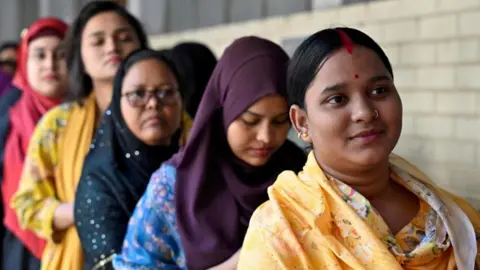
In brief
Today marks a pivotal moment in Bangladesh's political landscape as citizens cast their votes in the first election since the removal of Sheikh Hasina. More than 2,000 candidates are in the running, while the interim government advocates for constitutional change amid calls for a reformed political system. In light of previous upheaval leading to numerous casualties, security is a top priority, with thousands of police and soldiers deployed.
Votes are being counted in Bangladesh after the country held its first election since student-led protests ousted prime minister Sheikh Hasina in 2024.
More than 2,000 candidates are vying for a seat in parliament, though none from Hasina's now-banned Awami League party.
As many as 1,400 protesters were killed during the 2024 uprising, the UN says - with Hasina accused of having directly ordered the crackdown, an allegation she denies.
The election pits the centre-right Bangladesh Nationalist Party (BNP) against a coalition led by the Islamist Jamaat-e-Islami which has joined forces with a party born out of the student uprising. Results are expected on Friday.
Voters were also casting their ballots in a referendum on constitutional change proposed by the interim government to fix what it has called a completely broken political system.
Nearly a million police and soldiers have been deployed to maintain law and order.
Speaking after voting, interim leader Muhammad Yunus said the country had ended the nightmare and begun a new dream.
He voted in the capital Dhaka, as did the two leading candidates, Tarique Rahman for the BNP and Jamaat's leader Shafiqur Rahman.

