
In brief
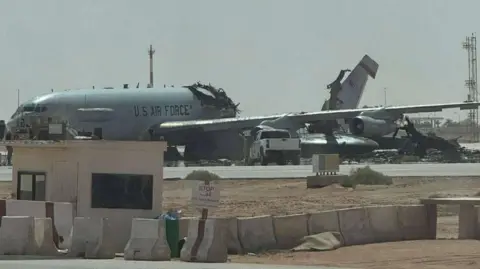
Recent verified images depict the E-3 Sentry, a critical US command and control aircraft, heavily damaged at the Prince Sultan air base in Saudi Arabia. This incident follows reports of an Iranian military attack that left twelve US personnel wounded, two severely. The aircraft appears to have been split in two, indicating a substantial impact. US Central Command has not commented yet, raising concerns over the ongoing hostilities between the US and Iran.
Verified pictures show a US command and control aircraft has been destroyed at an air base in Saudi Arabia. The images, initially shared on a Facebook page focused on US military news, reveal that the E-3 Sentry aircraft appears to have been split in two.
The photographs were confirmed to be taken at the Prince Sultan air base, located approximately 100km (62 miles) south-east of Riyadh, with visible features matching satellite imagery. While US Central Command has yet to comment on the situation, sources confirm that twelve US personnel were wounded in an Iranian military attack on the base, with two sustaining serious injuries. Additionally, reports suggest that at least two US refueling aircraft also suffered damage during the incident.
Iran's state-affiliated IRGC-linked Fars news agency claims a Shahed drone struck the E-3 aircraft. Furthermore, satellite images indicate a fire on the air base apron, approximately 1,600m (5,200ft) east of the aircraft, underlining the seriousness of the attack.
The Boeing E-3 Awacs, which stands for Airborne Warning and Control System, is based on a Boeing 707 framework featuring a distinctive rotating radar disc. It is used to track potential combat targets and provide early warnings during operations, reflecting the significance of its loss to US air operations in the region.
The aircraft has been operational since 1977 and is expected to remain in service with the USAF at least until 2035, marking this incident as a critical blow to US surveillance capabilities in the ever-turbulent Middle East.
