In brief
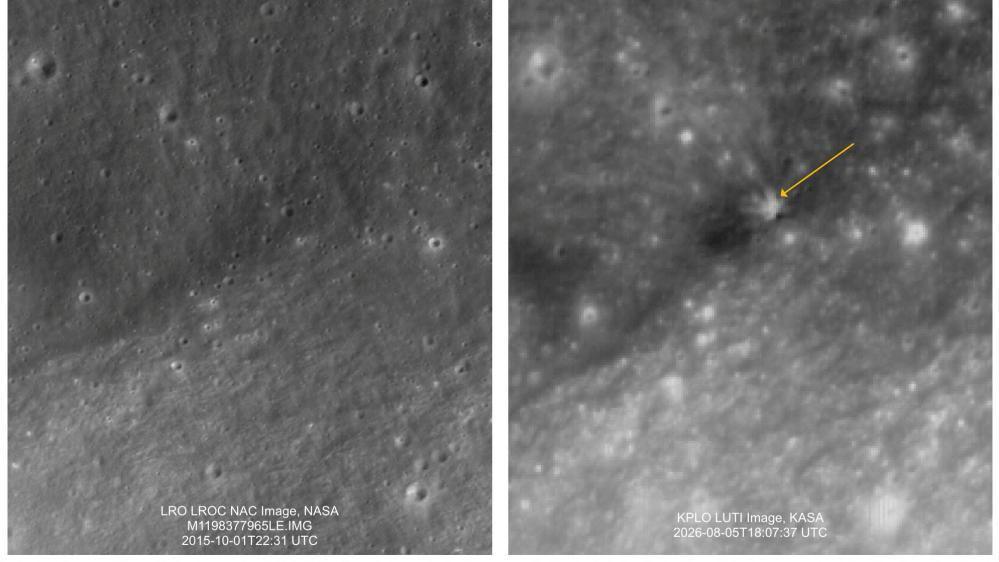
South Korea’s space agency KASA published images showing the Moon’s surface before and after a SpaceX Falcon 9 upper‐stage fragment crashed at 06:35 GMT on Wednesday. The lunar orbiter Danubri captured the impact, which SpaceX confirmed was unintentional. Experts warn that the debris highlights the growing problem of space debris as reusable rockets and satellites fill the orbital environment. The impact occurred at an estimated speed of 5,400 mph and involved a stage about the size of a five‑storey building, weighing around 4,000 kg on Earth. While the flash was too faint to observe with most telescopes, KASA and other observatories now analyze the data to assess potential hazards. The event underscores the need for better tracking and mitigation of space debris to preserve both scientific pursuits and orbital safety.
South Korea’s space agency has released images that show the Moon after part of a SpaceX rocket crashed into its surface on Wednesday.
The Korean AeroSpace Administration (KASA) said its lunar orbiter Danubri captured images after the impact, which it shared on X alongside photos of what the Moon’s surface looked like before the crash. View the tweet.
The debris struck the Moon at about 06:35 GMT, and SpaceX confirmed the impact was not intentional.
Experts point out that reusable Falcon 9 rockets are designed for upper‑stage returns to Earth and the shedding of other sections in space. The upper‑stage of this Falcon 9, sized like a five‑storey building, weighed roughly 4,000 kg on Earth and is predicted to have hit the Moon at approximately 5,400 mph (8,700 km/h).
While the flash of impact would have been far too faint to see with most telescopes, larger observatories—including Seoul’s KASA—are analysing the data. Astronomer Matt Bothwell of the University of Cambridge warned that space is becoming increasingly crowded as more missions launch, raising concerns about future navigation in Earth’s orbit.
Solar and gravitational forces had gradually pushed the discarded stage into a lunar‑approach trajectory. Over 18 months it gained speed and ultimately collided with the Moon, an event that, though posing no danger to Earth, illustrates the trajectory of debris in the near‑Earth environment.
SpaceX’s original launch in January 2025 carried two lunar landers; the upper stage’s detachment was meant to propel them towards the Moon. Its remaining mass now drifts in an orbit that swings between the Earth, Moon, and Sun, eventually intersecting the lunar surface.
Scientific teams now face the opportunity to study the impact’s effects on lunar geology and to refine debris‑tracking protocols that could mitigate future collisions.