
In brief
Venezuela has imposed a ban on six major international airlines, including Iberia and Turkish Airlines, for failing to resume flights amidst heightened tensions resulting from US military activities in the region. The ban follows warnings from the US about military deployments aimed at drug trafficking but perceived by Venezuela as a threat to its government. As thousands of passengers are affected, both nations signal a potential willingness for dialogue, with President Maduro highlighting the ongoing life in Caracas despite the challenges.
Venezuela has banned six major international airlines from landing in the country after they failed to meet a 48-hour deadline to resume flights there.
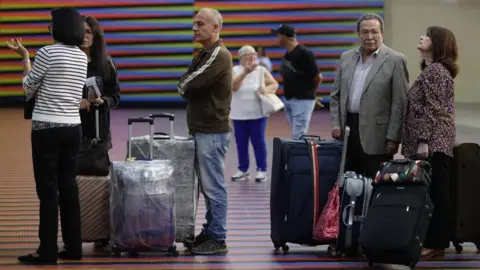
The airlines had temporarily suspended their routes into the capital, Caracas, after the US warned of heightened military activity in the area.
Angered by this, the Venezuelan government issued the carriers with an ultimatum that expired on Wednesday. While a number of smaller airlines continue to fly to Venezuela, thousands of passengers have been affected.
The US has deployed a large force to waters off Venezuela, which it says is to combat drug trafficking but which Venezuela's leader has denounced as an attempt to overthrow him.
Venezuela's civil aviation authority, which reports to the country's ministry of transport, announced on Wednesday that Iberia, TAP Portugal, Gol, Latam, Avianca, and Turkish Airlines would lose their landing and take-off rights with immediate effect.
In a reference to the heightened US military activity off the coast of Venezuela, it also accused the airlines of joining the actions of state terrorism promoted by the United States government and unilaterally suspending air commercial operations.
The US has deployed 15,000 troops and the world's largest aircraft carrier, the USS Gerald Ford, to within striking distance of Venezuela.
The US says the aim of the deployment, the largest by the US in the region since it invaded Panama in 1989, is to combat drug trafficking.
US forces have carried out at least 21 strikes on boats they say were carrying drugs, killing more than 80 people. However, they have not provided evidence that the boats carried drugs and many analysts have pointed out that the US deployment is unusually large for a counter-narcotics operation.
The Venezuelan government thinks the aim of the operation is to depose President Nicolás Maduro, whose re-election last year was denounced by the Venezuelan opposition and many foreign nations as rigged.
Amid the rising tensions, the US Federal Aviation Authority (FAA) issued a warning on Friday to flight operators operating in Maiquetía, the international airport serving Caracas. It urged airlines to exercise caution... at all altitudes due to the worsening security situation and heightened military activity in and around Venezuela.
It was in the wake of that warning that the now-banned airlines suspended their flights to Venezuela.
An attempt by aviation industry body Iata to defuse the situation - by stressing that its member airlines were keen to restore operations - failed to appease the Venezuelan government.
In recent days, both Maduro and his US counterpart Donald Trump have signalled a willingness to hold direct talks. Asked about it on Air Force One, Trump said that he might talk to Maduro, but also warned that we can do things the easy way, that's fine, and if we have to do it the hard way that's fine, too.
Maduro, meanwhile, uploaded a video of himself driving around Caracas pointing to Christmas decorations, in what appeared to be an attempt to show that life in the city was going on as normal.


