
In brief
The article delves into the rich tradition of Indian art that reinterprets the birth of Jesus Christ, highlighting the fusion of Islamic and modernist elements in works by significant artists like Jamini Roy and Angelo de Fonseca. By contextualizing these pieces within the cultural and historical milieu of India, it reveals how diverse artistic influences coexist and reshape religious narratives.
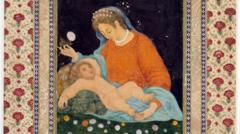
The birth of Jesus Christ, a pivotal moment in biblical history, has traditionally been illustrated by Western artists, whose creations have greatly influenced global perceptions of this event. However, Indian artists have reimagined Christ's nativity through a distinct local lens, resulting in artwork that captures the essence of Christianity while incorporating indigenous styles and motifs.One notable contributor to this artistic discourse was Mughal emperor Akbar, who, in the 17th century, played a crucial role in introducing Christianity to northern India by inviting Jesuit missionaries to his court. These missionaries not only shared sacred texts but also brought European artistic traditions, which the Mughal court painters expertly melded with Islamic aesthetics. Historian Neha Vermani highlights a significant piece from this era where Mughal artists portrayed Emperor Jahangir within the nativity scene—a departure from traditional depictions that feature Mary, Joseph, and baby Jesus. Vermani notes that Mughal rulers viewed themselves as just rulers, fostering religious coexistence and harmony.Continuing this rich tradition, 18th-century Mughal paintings are characterized by their bright colors, ornate details, and stylized figures that resonate with both Islamic and local artistic traditions. In a more modern context, the work of Jamini Roy, born in 1887 in West Bengal, exemplifies the innovative blending of Indian folk art with Christian themes. Art critic W.G. Archer acknowledged that for Roy, Christ symbolized a Santhal figure, reflecting the shared values of simplicity and sacrifice. Roy’s works are rendered in a folk-modernist style, reinforcing the significance of Christianity within Indian artistic expression.Angelo de Fonseca, another vital figure in this narrative, hailing from Goa, crafted a distinctive Christian iconography that integrated both Eastern and Western influences. His depictions of figures like Mary challenge tropes by presenting her as an Indian woman adorned in traditional attire, thus situating biblical stories within familiar Indian environments. As highlighted by Rinald D'Souza from the Xavier Centre of Historical Research, Fonseca aimed to redefine Christianity as a tradition rooted in the Indian subcontinent, countering the perception of its Western origins.In summary, the exploration of Christ's birth through Indian artistry not only showcases the rich tapestry of cultural exchanges but also redefines religious narratives within the framework of local traditions and experiences. This unique blend of Islamic motifs and modernism not only pays homage to India's diverse heritage but also challenges the predominant Western-centric view of Christian art.