Forensic Experts Confirm Pellet Gun Use in Delhi Protest
Independent ballistic experts told the BBC that injuries sustained by some Cockroach Janta Party (CJP) supporters during the violent July 20 protest in Central Delhi were caused by pellet guns.
Central Delhi witnessed overwhelming violence when tens of thousands of protestors tried to march to parliament to demand education reforms and the resignation of the education minister. Police and paramilitary personnel were seen attacking crowds with wooden sticks, batons and tear gas. Delhi Police claimed 60 protestors and 118 officers were injured, though CJP said the injured number was much higher.
In the days after the crackdown the government has not confirmed media reports of pellet gun use, but the BBC has confirmed at least four cases where protesters received hospital treatment for wounds that experts say are caused by pellet guns.
Pellet guns are shotgun‑type weapons designed for bird hunting, firing 200‑400 small metal pellets. When fired against crowds the pellets spread in a wide arc, striking people indiscriminately. The weapons are banned in several countries.
We spoke to two injured men who believe they were shot by security forces. We showed photographs and videos to two independent armament and forensic experts. A senior hospital official confirmed support for a fourth man who also received treatment for pellet wounds.
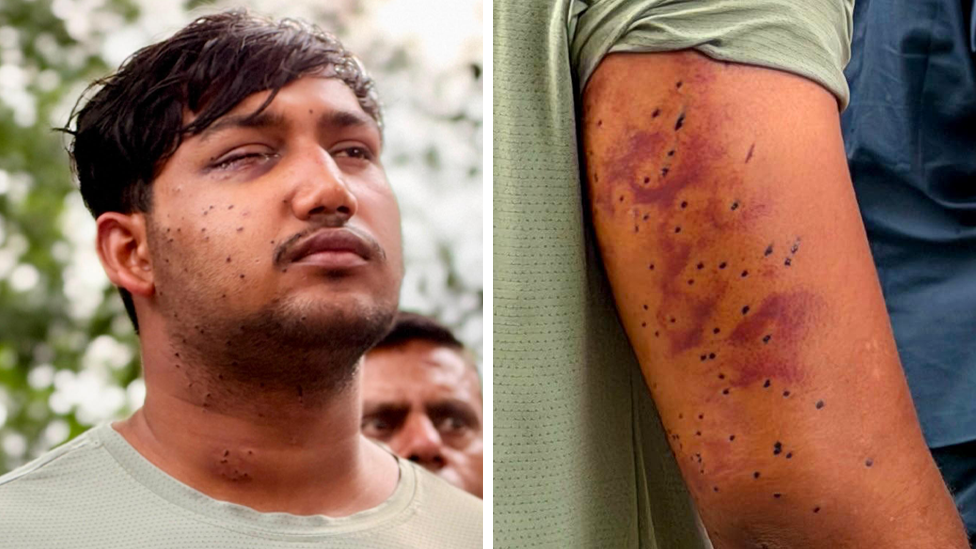
The experts say dozens of tiny round punctures are tell‑tale signs of injuries caused by birdshot. “The injuries depicted are definitely from a pellet gun,” UK‑based ballistics forensic scientist Philip Boyce told the BBC, adding that the weapon used is a 12‑gauge pump‑action shotgun.
"These pellet injuries can be quite devastating, especially at close range. The injuries I see in Delhi are not at close range, they're at least 50 feet away, but they can still be devastating and potentially life‑threatening even from 100 feet," Boyce added.
NR Jenzen‑Jones, director of Armament Research Services (ARES) in the UK, said images and video from the protests show the police using shotguns for crowd control and that injuries are strongly consistent with the use of birdshot.
“While shotguns are a common tool in many states’ less‑lethal arsenals, Indian law‑enforcement agencies have a long history of employing shotgun cartridges loaded with small lead pellets—known as ‘birdshot’—in crowd‑control scenarios,” Jenzen‑Jones said. "These pellets are not safe; they can result in life‑changing or even life‑threatening injuries and pepper the body with toxic lead that can be difficult to remove safely.”
India has long used pellet guns in Indian‑administered Kashmir since 2010, with Human Rights Watch reporting injuries to several thousand people, at least 17 deaths and dozens of blinding incidents.
Two of the protesters we spoke to were injured in Connaught Place after 4 pm local time on July 20.
Mohit, a 28‑year‑old journalist, told the BBC he saw a security personnel aim a gun at him, ran in the opposite direction, and a few seconds later felt a burning sensation on his right arm and back. An X‑ray at Safdarjung hospital showed 26 pellet wounds in his right elbow and four on his upper right back.
Shaikh Irshad Mansoori, who worked for a Gurugram‑based firm, was shot while protesting at Jantar Mantar. He said scans revealed over 40 pellets in his body, including deep‑lying ones in his neck, left eye muscle and under his nose. Five of the pellet wounds were removed; one in the neck was left due to risk of removal.
When the first claim of pellet gun use emerged, Delhi police called it "completely false and misleading," stating they did not possess pellet guns. Indian media reports now say the shots were fired by the RAF, which reports to the Central Reserve Police Force (CRPF). The BBC has sent questions to CRPF chief Gyanendra Pratap Singh, but no response yet.
Later in Parliament, government minister Jitendra Singh said only tear gas was used, and no "bullets" were fired, but he did not address pellet usage. Rahul Gandhi, leader of the opposition, demanded that Home Minister Amit Shah be sacked because both the Delhi police and CRPF report to Shah.
During a press conference, Rahul Gandhi was accompanied by 19‑year‑old Delhi University student Sahil Lochab, whose face and back of his right arm show dozens of fine holes. He later said he could not see who fired the pellet gun but it came from the side where the forces were.
"I want justice. Whoever did this to me doesn't deserve to be in power," Sahil said, as the protest continued to draw national attention.
Photo‑journalists and eyewitnesses will continue to monitor the situation, as officials keep denying the use of pellet guns in the capital. The incident could represent a new chapter in India’s use of less‑lethal crowd‑control weapons, with implications for international human rights standards.