Political parties often endure defeat but struggle when power slips away. In the case of the Trinamool Congress (TMC) in West Bengal, the world’s most populous eastern state of over a hundred million, a quick fall from grace has become all too rapid.
Just a month after the BJP under Narendra Modi swept to power in May 2026, the TMC found itself attacked from within. Roughly three‑quarters of its legislators declared rebellion, accusing the party of forging signatures on legislative documents and demanding that Banerjee’s nephew, Abhishek Banerjee, step aside. The revolt was not confined to the state house: twenty of the TMC’s twenty‑eight MPs have written to the parliamentary speaker to detach from the party’s parliamentary group and align with the ruling alliance.
The alarming speed of the unraveling points to a structural weakness. Political scientist Dwaipayan Bhattacharyya says that unlike the communist movement Banerjee toppled in 2011, the TMC never built a coherent ideology to survive a loss of office. Its cohesion relied almost entirely on Banerjee’s charisma and the patronage that comes with governance.
The loss of executive authority and of Banerjee’s personal brand left local power brokers exposed—suspected of corruption, facing investigations, and threatened by rival fortunes. This made the opportunity to defect more tempting. Rahul Verma of the Centre for Policy Research notes how the BJP’s rise has changed local incentives: a regional party that has once lost power now offers a new centre of power, resources and political protection, enabling entire factions to break away.
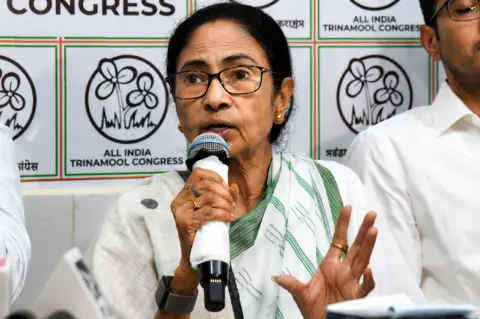
The party’s internal turbulence has already materialised on the ground. In the Falta constituency, which the TMC won by 56% in 2021, a public meeting that drawn only a few hundred people last month underscored the decline of Banerjee’s magnetic pull.
Despite the immediate crisis, Banerjee remains defiant. She has labelled the BJP victory as illegal and immoral, alleging that nearly one hundred seats were looted. “Opponents are opportunists,” she said, insisting that the party can rebuild and that the people of Bengal are still loyal to its workers, not its leaders.

The path forward is uncertain. Whether the rebels will eventually return to Banerjee’s fold or whether the TMC can restructure into a viable political force remains to be seen. Yet the current crisis illustrates a new wave in Indian politics in which regional parties, once anchored by charismatic founders, confront the dual test of ideological cohesion and the lure of national powerhouses such as the BJP. The global community will watch how this reshuffles reshape India’s political map and the prospects for democratic stability in the nation’s most populous state.