In brief
Nicolas Sarkozy, the erstwhile president of France, has commenced a five-year prison sentence after being convicted of conspiracy related to funding his 2007 election campaign through Libyan money. His incarceration marks a historic moment in French politics, making him the first former president to serve jail time since World War II. Despite protests of his innocence, Sarkozy is set to serve his term in La Santé prison, where he will have limited amenities and isolated conditions for his safety. The case has sparked varied reactions across France, showcasing deep divisions over Sarkozy's legacy and the implications of his conviction.
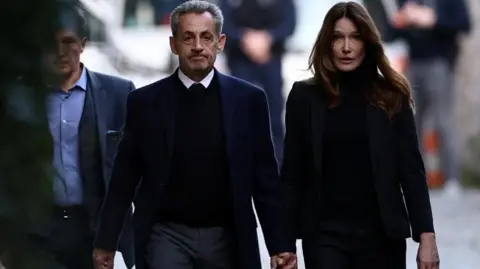
Nicolas Sarkozy will become the first French ex-president to go to jail, as he starts a five-year sentence for conspiring to fund his election campaign with money from late Libyan dictator Muammar Gaddafi.
Not since World War Two Nazi collaborationist leader Philippe Pétain was jailed for treason in 1945 has any French ex-leader gone behind bars.
Sarkozy, who was president from 2007-2012, has appealed against his jail term at La Santé prison, where he is to occupy a cell roughly measuring 9 sq m (95 sq ft) in the jail's isolation wing.
More than 100 people stood outside the jail, as his son Louis, 28, called on supporters for a show of support.
Another son, Pierre, asked for a message of love - nothing else, please.
Nicolas Sarkozy, 70, was due to arrive at 10:00 (08:00 GMT) at the infamous 19th-Century prison in the Montparnasse district south of the River Seine. He continues to protest his innocence in the highly controversial Libyan money affair.
Sarkozy has said he wants no special treatment at the notorious La Santé prison; however, he has been placed in the isolation section for his own safety as other inmates are notorious drugs dealers or have been convicted for terror offences.
Other than Philippe Pétain, the only other former French head of state to have been jailed was King Louis XVI before his execution in January 1793.
Inside his cell, he will have a toilet, shower, desk, and small TV. He will be allowed one hour a day for exercise, by himself.
Last week, he was received at the Élysée Palace by President Emmanuel Macron, who told reporters on Monday it was normal that on a human level I should receive one of my predecessors in that context.
In a further measure of official support for the ex-president, Justice Minister Gérald Darmanin said he would visit him in prison as part of his role in ensuring Sarkozy's safety and the proper functioning of the jail.
I cannot be insensitive to a man's distress, he added.
Ahead of his arrival at La Santé prison, Sarkozy gave a series of media interviews, declaring, I'm not afraid of prison. I'll keep my head held high, including at the prison gates.
Sarkozy has continuously denied doing anything wrong in a case involving allegations that his 2007 presidential campaign was funded by millions of euros in Libyan cash. Although he was cleared of personally receiving the money, he was convicted of criminal association with two close aides, Brice Hortefeux and Claude Guéant, for discussing secret campaign financing with the Libyans.
As he lodged an appeal, Sarkozy is still considered innocent but has been told that he must go to jail due to the exceptional seriousness of the facts.
Sarkozy stated he would take two books into prison: a life of Jesus and The Count of Monte Cristo, the tale of a man wrongfully imprisoned who seeks vengeance against his prosecutors.