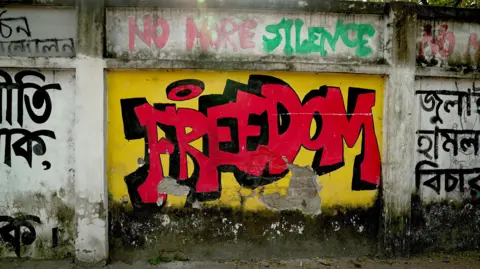
Rahat Hossain was almost killed trying to save his friend in a youth uprising that became one of the bloodiest episodes in Bangladesh's history.
Footage of him trying to pull Emam Hasan Taim Bhuiyan, who'd been shot by police, to safety went viral during a revolution that toppled the country's leader.
During a crackdown on protests on July 20, 2024, Hossain, 24, and Bhuiyan, 19, took shelter at a Dhaka tea stall but police dragged them out, beat them, and ordered them to run.
Bhuiyan was shot. Seeing him sprawled on the ground, Hossain began dragging him away, but police kept shooting. Hossain felt a bullet strike his own leg.
I had to leave him behind, Hossain says. Bhuiyan was later declared dead in the hospital.
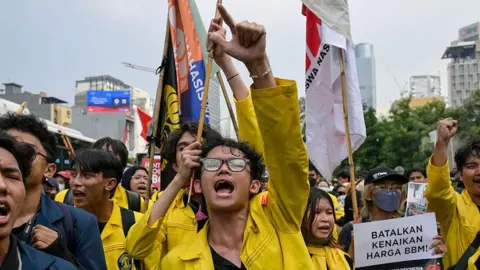
Violence like this became the catalyst that turned student-led demonstrations into a mass protest nationwide, with its epicenter in the capital, Dhaka. Within a fortnight, the government had been swept from power, with Prime Minister Sheikh Hasina fleeing the country.
Up to 1,400 people died during the protests, the vast majority killed in the security crackdown ordered by Hasina according to the United Nations.
Hasina's downfall seemed to promise a new age. The uprising was considered the first and most successful of a series of Gen Z protests around the world.
Some student leaders in Bangladesh went on to hold key posts in an interim government, trying to shape the kind of country they had taken to the streets to fight for. They were expected to play a role in the country's future administration, after decades of rule by Hasina's Awami League and the rival Bangladesh Nationalist Party (BNP).
But as general elections loom next week, the students' newly formed political party is badly fractured and women in the movement largely sidelined. With the Awami League banned, other long-established parties are filling the vacuum.
This lack of faith in the National Citizen Party (NCP) is a major blow to the student leaders.
During the upcoming elections, the NCP is allying with Jamaat-e-Islami, a party with a controversial past, to gain traction against other established parties. However, internal divisions and the sidelining of women activists within both parties raise concerns about the future of this political coalition.
As Bangladesh approaches the elections amidst evolving political dynamics, it remains to be seen if the ideals of the youthful uprising can be realized amidst ongoing struggles against entrenched political influences.