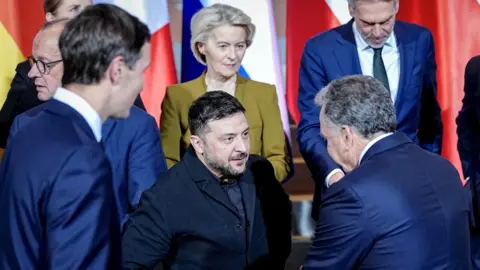
The US has said it is ready to offer Ukraine Nato-like security guarantees to safeguard an eventual ceasefire, following talks in Berlin with European officials and a delegation from Kyiv.
The very strong guarantees would be modelled on NATO's Article 5 clause of mutual protection, US officials said, adding that the Russians would hopefully agree to them.
While US officials talked up progress towards ending the war, there was little detail on how the thorny issue of Ukraine's sovereignty would be resolved in any peace deal.
Ukraine's Volodymyr Zelensky described the meeting as productive but not easy.
He added that Kyiv needed a clear understanding of security guarantees before it could make any decisions about other contentious issues.
Ukraine has long argued it needs watertight guarantees to ensure that Russia respects any ceasefire and does not attack the country again.
US officials described the security guarantees on offer as the platinum standard, but cautioned the deal would not be on the table forever.
On Sunday, Zelensky signalled for the first time that as a compromise he would give up ambitions to join NATO in exchange for strong guarantees.
While there appears to be significant movement on the issue of security, the eastern region of the Donbas remains a major sticking point.
The US is now suggesting an economic-free zone could be established in the contested part of the Donbas, but that would require Ukraine accepting to withdraw from the areas it still holds, while Russia would not be expected to do the same.
It seems to me that [the US and Ukraine] so far have different positions, to be honest, Zelensky said.
US officials said that if the economic free zone could be defined, then it will really be up to the parties to work out the final issues of sovereignty.
But Moscow and Kyiv remain far apart on the issue of the Donbas. Russia mostly occupies the region and it wants Kyiv to hand it over in its entirety, which Ukraine is staunchly refusing to do.
The US officials said Washington was now willing to submit a security package for Senate ratification.
Speaking from the White House, US President Donald Trump said he had spoken to Zelensky and European leaders, describing it as a very good talk.
I think we're closer now than we have been, ever, he said, referring to reaching a peace deal.
German Chancellor Friedrich Merz, who hosted the discussions, struck a similar tone earlier on Monday, saying this is the first time a ceasefire is conceivable.
It's a huge progress which I welcome very much, he said, describing Washington's security guarantees as remarkable.
Several European leaders, as well as European Commission President Ursula von der Leyen, will join further talks with the Ukrainian and US delegations on Monday evening.
At the core of the discussions in Berlin is the 20-point peace plan proposal which Ukraine presented to the US last week, to counter an initial American plan that was seen as heavily favouring Russia.
Details haven't been shared, but last week Zelensky said the points should be seen as a foundation on which to build provisions for the reconstruction of Ukraine and security guarantees.
Any proposal hashed out by the Ukrainian, American and European side will still have to be presented to Moscow – although Zelensky said that the US delegation so to speak present the Russian side's perspective, because they relay Russia's signals, demands, steps, and indications of readiness or lack thereof.
The Kremlin said it expected the US to provide it with the concept discussed on Monday.
The talks in Berlin come at a crucial time for Ukraine, which is enduring its fourth winter of war amid sustained power cuts caused by Russia's attacks on its energy facilities.
Over the weekend more than a million Ukrainian households were left without electricity following a barrage of strikes. Zelensky said on Monday that there was not a single functioning power station that had not been attacked by the Russians.
Later this week, EU countries will be voting on a plan to send €90bn (£78.6bn) worth of frozen Russian assets held in a Belgium-based financial institution to prop up Ukraine's economy.
On Friday, EU governments agreed to immobilise the Russian assets indefinitely - but there is no consensus yet on whether they can be sent to Ukraine. Belgium has been resisting the legally contentious proposal, and in recent days other countries, including Italy, have said alternative options should be put forward.
EU foreign policy chief Kaja Kallas acknowledged the discussions were increasingly difficult.
But we're doing the work, and we still have some days, she added.