In brief
At a Dubai seminar on 5th November 2026, the Zayed International Foundation for the Environment, together with ASHRAE Falcon Chapter UAE and Curtin University Dubai, declared indoor environmental quality (IEQ) a fundamental pillar of sustainability. The event stressed that healthy indoor spaces complement energy‑efficient buildings and called for stronger collaboration among academia, industry and government. The Foundation underscored the role of AI‑driven monitoring and low‑carbon solutions in creating healthier, more productive indoor environments.
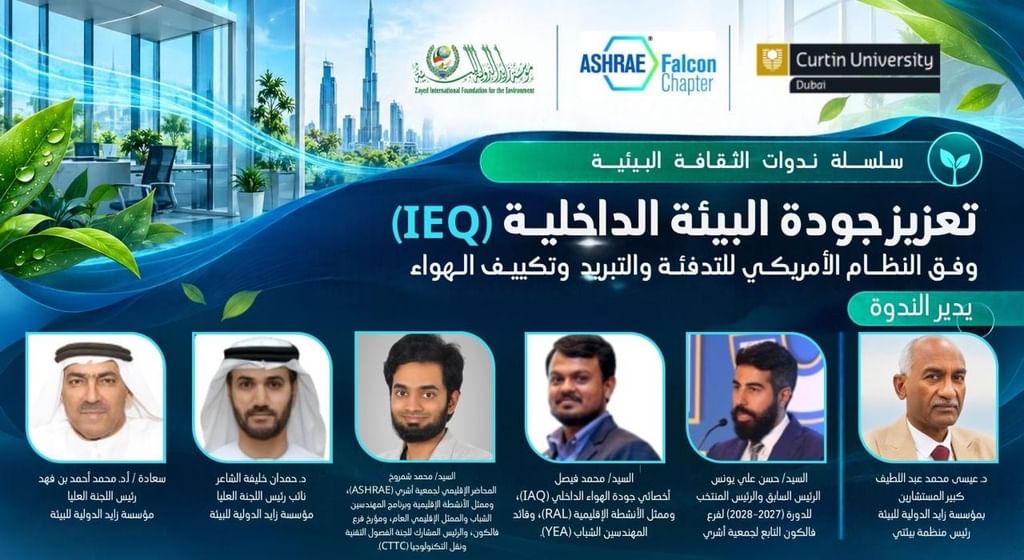
The Zayed International Foundation for the Environment made a sweeping statement during a specialised awareness seminar held in Dubai on 5 November 2026, declaring that Indoor Environmental Quality (IEQ) is now a core marker of sustainability. The event, organised with the ASHRAE Falcon Chapter UAE and Curtin University Dubai, carried the theme “Advancing Indoor Environmental Quality in Accordance with American Standards.”
Mohammed Ahmed bin Fahad, Chairman of the Higher Committee of the Zayed International Foundation for the Environment, opened the session with these words:
I am here to affirm that sustainable buildings can no longer be assessed solely on the basis of energy efficiency. Their true value lies in providing healthy and safe environments that enhance human well‑being while preserving natural resources.
Mr. bin Fahad highlighted the necessity of integrating IEQ with smart technologies, AI‑based monitoring systems and low‑carbon solutions to advance sustainable development goals. He also called attention to the legacy of Sheikh Zayed bin Sultan Al Nahyan, noting that his environmental vision continues to guide national efforts.
ASHRAE’s former president, Hassan Ali Younes, presented IEQ as an integrated framework that brings together indoor air quality, thermal comfort, lighting, acoustics, water quality, humidity management and other elements that affect occupants’ health and productivity. In his remarks, Mr. Younes said:
Recent studies demonstrate a direct relationship between indoor environmental conditions and levels of performance, health and well‑being, underscoring the pivotal role of ASHRAE standards in establishing scientific frameworks for healthy and sustainable environments.
Experts present at the seminar underscored that future sustainable city planning must embed IEQ within long‑term strategies, calling for closer collaboration across academia, industry and government. This call to action comes as climate challenges accelerate and new building technologies, such as AI‑driven environmental sensors, become more mainstream.
Dr. Lina Khalifa from Curtin University Dubai explained how AI monitoring tools can dynamically adjust ventilation, lighting and thermal settings to maintain optimal IEQ levels, thus reducing energy consumption while improving occupant well‑being. She noted that the integration of low‑carbon materials with these technologies can yield buildings that are both resilient to climate variability and conducive to human health.
Implications for Sustainable Development
The Foundation’s message implies a shift in sustainability metrics: energy efficiency will no longer be the sole criterion for assessing a building’s environmental performance. Instead, IEQ will be quantified through health‑related metrics, prompting building codes, certification schemes and urban policies to adopt new benchmarks that account for air purity, thermal comfort and psychological well‑being.
While the seminar focused on Dubai, the principles discussed are applicable globally. By aligning building standards with American ASHRAE guidelines, countries can accelerate the transition towards healthier indoor environments and, in turn, improve productivity and reduce healthcare costs.