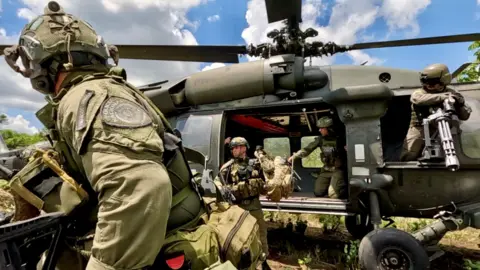
The Black Hawk helicopter was ready for take-off, its rotor blades slicing through the heat of the Colombian Amazon. Alongside the Jungle Commandos—a special police operations unit trained in part by Britain's SAS—journalists from the BBC joined forces in a high-stakes mission against drug trafficking.
Armed to the teeth, the commandos faced a familiar tension, one that surfaces any time the drug trade is targeted in Colombia. Facing resistance from both drug cartels and former guerrilla factions, they navigated towards Putumayo, an area known as Colombia's cocaine heartland, responsible for approximately 70% of the world's supply.
As the helicopter flew over patches of vibrant greenery—the tell-tale sign of coca plant cultivation—tensions simmered aboard. The commandos prepared for the likelihood of encountering violent resistance during their operations.
When they landed in a jungle clearing, they quickly located a crude cocaine lab, partially obscured in the foliage. The lab, comprising basic structures and vital supplies necessary for drug production, was proof of the drug trade's continuing prevalence. Those who emerged from the shadows near the lab were questioned, but no arrests were made, in line with Colombia's strategy that prioritizes dismantling high-level operations over targeting impoverished local workers.
Colombia's defense strategy has come under scrutiny, especially following comments from former President Donald Trump, who questioned the efforts of Colombian President Gustavo Petro. While Petro claimed his administration seized record amounts of cocaine, critiques linger as cocaine production soars to new heights.
Major Cristhian Cedano Díaz, a veteran of the war on drugs, candidly acknowledged the futility of the fight against cocaine labs which can be rebuilt within a day. Despite this, he insists that ongoing operations like theirs effectively impact the profitability of drug gangs by destroying crops and essential chemicals.
As the commandos returned from their missions, Major Cedano reflected on the continuous cycle and evolution of drug trafficking. With advancements such as the use of drones and cryptocurrencies by drug gangs, the war on drugs appears more complex than ever.
From the perspective of local farmers like "Javier," cultivating coca becomes a harsh necessity in regions bereft of economic alternatives. Javier's struggles illustrate the cyclical nature of poverty and the challenges faced by those on the ground who often have no choice but to engage in cocaine production to support their families.
The interplay of military action, local struggles, and international drug policies paints a grim picture of Colombia's drug epidemic and showcases the urgent need for systematic change that addresses both supply and demand.
Armed to the teeth, the commandos faced a familiar tension, one that surfaces any time the drug trade is targeted in Colombia. Facing resistance from both drug cartels and former guerrilla factions, they navigated towards Putumayo, an area known as Colombia's cocaine heartland, responsible for approximately 70% of the world's supply.
As the helicopter flew over patches of vibrant greenery—the tell-tale sign of coca plant cultivation—tensions simmered aboard. The commandos prepared for the likelihood of encountering violent resistance during their operations.
When they landed in a jungle clearing, they quickly located a crude cocaine lab, partially obscured in the foliage. The lab, comprising basic structures and vital supplies necessary for drug production, was proof of the drug trade's continuing prevalence. Those who emerged from the shadows near the lab were questioned, but no arrests were made, in line with Colombia's strategy that prioritizes dismantling high-level operations over targeting impoverished local workers.
Colombia's defense strategy has come under scrutiny, especially following comments from former President Donald Trump, who questioned the efforts of Colombian President Gustavo Petro. While Petro claimed his administration seized record amounts of cocaine, critiques linger as cocaine production soars to new heights.
Major Cristhian Cedano Díaz, a veteran of the war on drugs, candidly acknowledged the futility of the fight against cocaine labs which can be rebuilt within a day. Despite this, he insists that ongoing operations like theirs effectively impact the profitability of drug gangs by destroying crops and essential chemicals.
As the commandos returned from their missions, Major Cedano reflected on the continuous cycle and evolution of drug trafficking. With advancements such as the use of drones and cryptocurrencies by drug gangs, the war on drugs appears more complex than ever.
From the perspective of local farmers like "Javier," cultivating coca becomes a harsh necessity in regions bereft of economic alternatives. Javier's struggles illustrate the cyclical nature of poverty and the challenges faced by those on the ground who often have no choice but to engage in cocaine production to support their families.
The interplay of military action, local struggles, and international drug policies paints a grim picture of Colombia's drug epidemic and showcases the urgent need for systematic change that addresses both supply and demand.