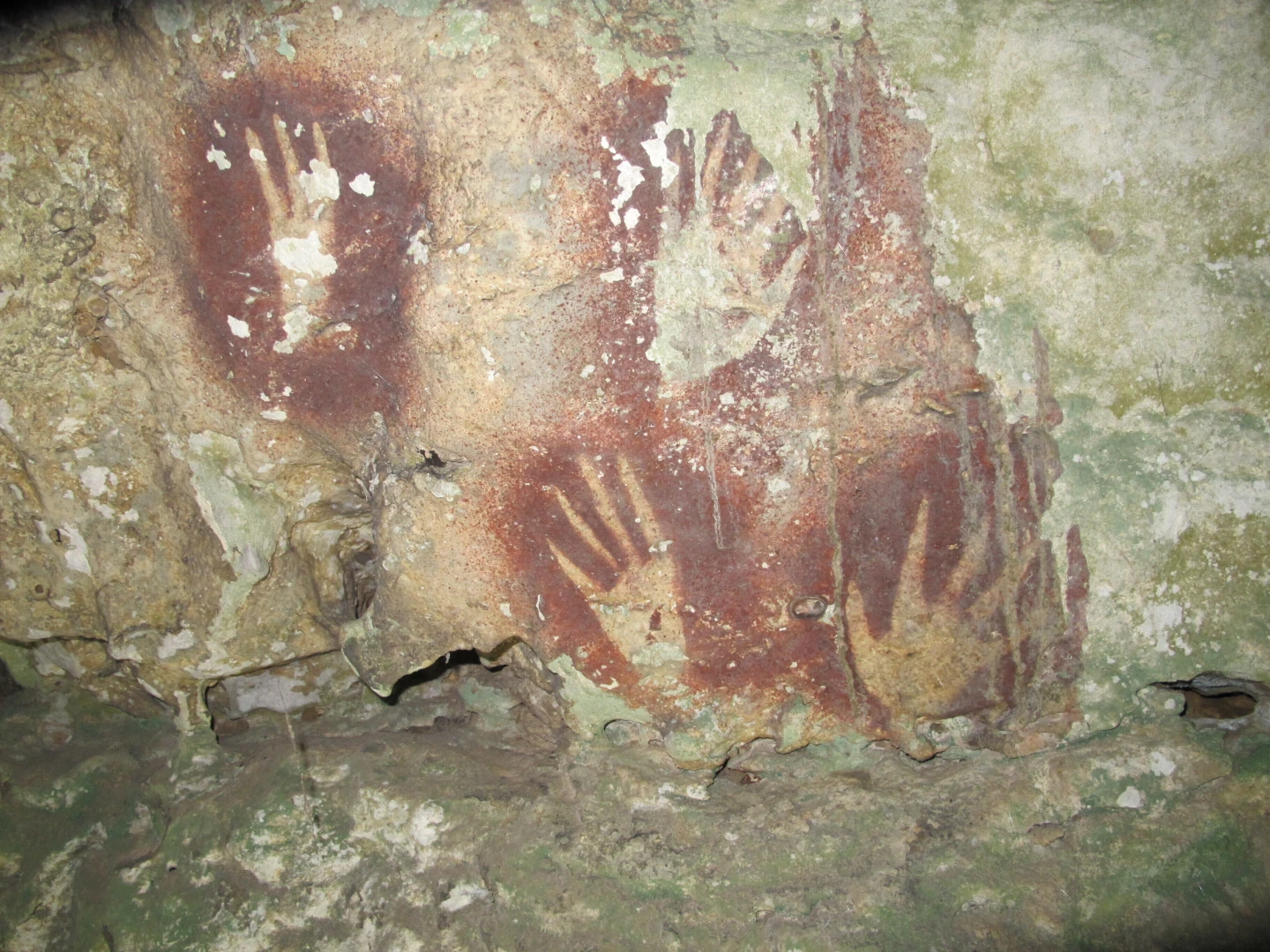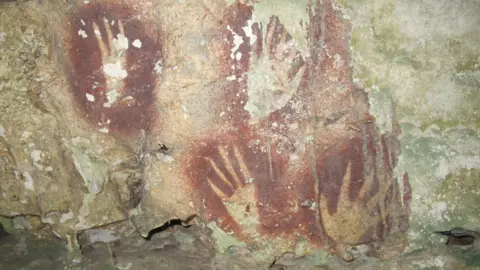
A stencilled outline of a hand found on the Indonesian island of Sulawesi is being hailed as the world’s oldest known cave painting, dated at 67,800 years old. Researchers assert that this significant find not only pushes back the timeline of human creativity but also introduces new perspectives on early symbolic thought among Homo sapiens.
The painting reveals a red outline of a hand, which features modified fingers crafted into a claw-like shape, indicating a sophisticated level of imagination that is considered a hallmark of human creativity. This discovery predates the previously recognized oldest cave art from Spain by approximately 1,100 years, thereby reshaping understandings of when and where art first appeared.
Moreover, this find bolsters the theory that our species reached the wider Australia–New Guinea landmass, known as Sahul, around 15,000 years earlier than some researchers had previously argued. The implications of this discovery broaden the understanding of when sophisticated cognitive abilities might have developed in early human populations.
In recent years, numerous discoveries on Sulawesi have challenged the notion that artistic expression emerged solely in Ice Age Europe. Increasing evidence indicates that early humans had an innate capacity for creativity that permeated various regions. Cave art is regarded as a pivotal marker for when humans began to engage in abstract thinking and symbolic representation.
Professor Adam Brumm of Griffith University, who co-led the study published in the journal Nature, stated that the evidence now suggests that artistic creativity isn't a uniquely European phenomenon, but a trait that spans back to Africa and is deeply ingrained in human culture.
The discovery of this oldest painting in a limestone cave called Liang Metanduno adds weight to the narrative that art was not merely a local venture but indicative of a broader cultural practice that persisted over millennia.
Historical views, which predominantly focused on artistic developments in Europe during the Ice Age, are increasingly being re-evaluated. As evidenced by the findings in Sulawesi and Africa, it appears that humanity’s capacity for creativity may have existed far longer than previously recognized.
Understanding the timeline of human artistic development is vital, especially as it pertains to the migration patterns of ancient human populations. These insights compel archaeologists to reassess theories about the emergence and spread of modern human behavior globally, thus providing a richer context for the narrative of our ancestral past.