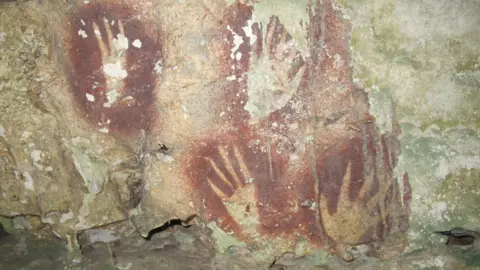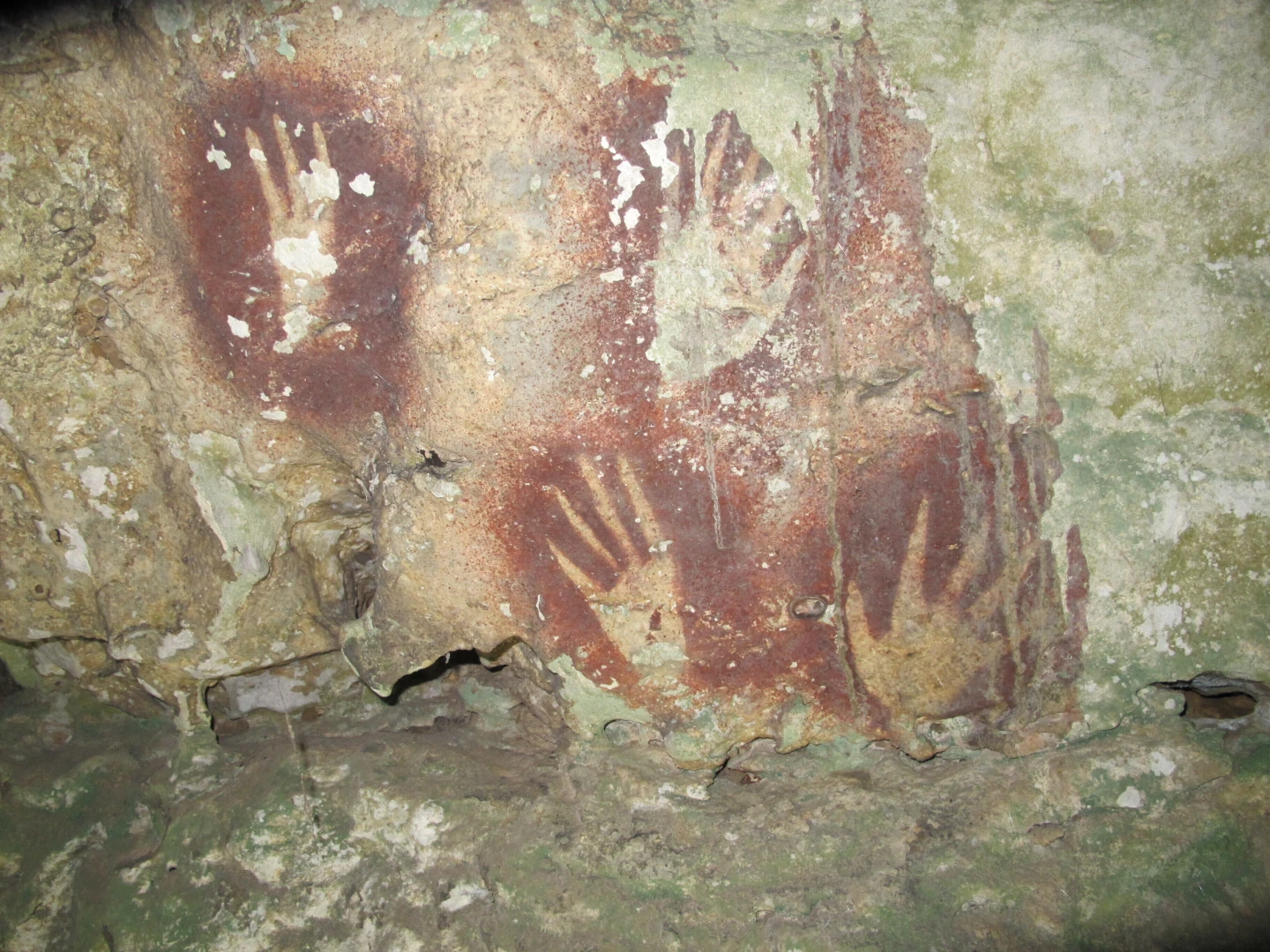
NEW YORK (AP) — Handprints on cave walls in a largely unexplored area of Indonesia have been identified as potentially the oldest rock art studied so far, dating back to at least 67,800 years ago.
The tan-colored prints, analyzed by Indonesian and Australian researchers on the island of Sulawesi, were created by blowing pigment over hands placed against the cave walls, leaving an outline. Certain fingertips were also intentionally modified to appear more pointed.
This prehistoric artistic expression hints at a vibrant creative culture on the Indonesian island. To date the paintings, scientists examined mineral crusts formed over the art.
Genevieve von Petzinger, an independent paleoanthropologist, expressed her excitement regarding the findings, stating, It fits everything I’d been thinking.
Indonesia is recognized for hosting some of the earliest cave drawings in the world. Scientists have analyzed various forms of ancient art globally, including simple markings that date back thousands of years. For example, cross-hatched markings on a South African rock have been dated to about 73,000 years ago.
The discovery of these cave prints in southeastern Sulawesi stands out as the oldest identified on cave walls, representing a more complex tradition of rock art that could reflect shared cultural practices, according to study author Maxime Aubert from Griffith University, whose findings were published in the journal Nature.
Scientists are keen to learn when early humans began making art, evolving from simple dots and lines to more complex representations. These cave drawings contribute to establishing a timeline for the emergence of human creativity.
It remains unclear whose hands created the prints. These could belong to an early group of humans known as Denisovans, who lived in the region and may have interacted with our Homo sapiens ancestors. Alternatively, they may have been made by modern humans migrating from Africa, who might have passed through the Middle East and Australia during this period.
Other recently discovered drawings in the same area, such as a human figure and various animals, were determined to be significantly younger, created around 4,000 years ago.
Scientists believe there may be even older artwork on nearby islands that remains to be uncovered. Future studies might illuminate how these artistic traditions spread globally and their role in the early narratives of humanity.
“For us, this discovery is not the end of the story,” Aubert noted. “It is an invitation to keep looking.”
The Associated Press Health and Science Department receives support from the Howard Hughes Medical Institute’s Department of Science Education and the Robert Wood Johnson Foundation. The AP is solely responsible for all content.