In brief
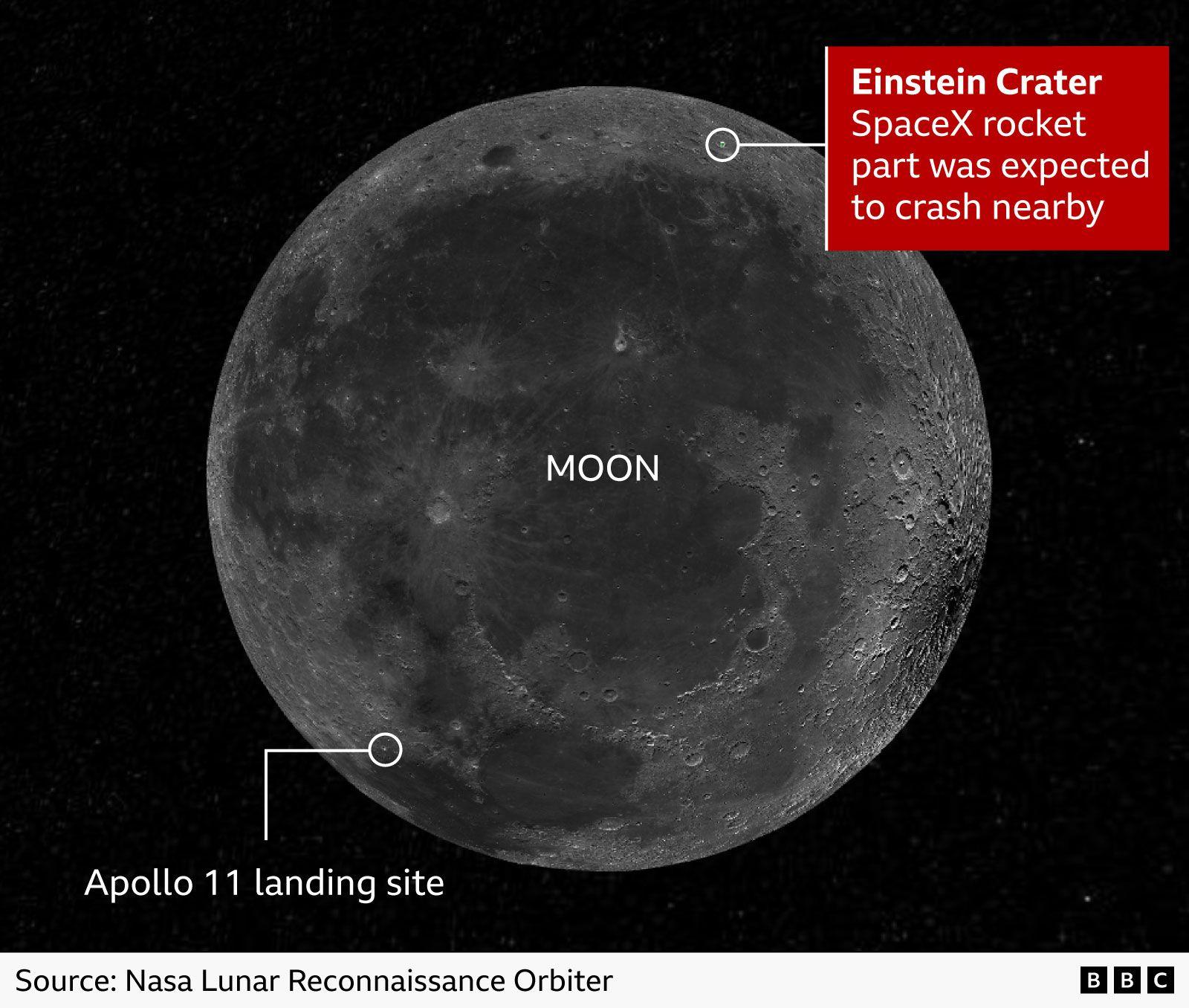
A Falcon 9 reusable rocket’s upper stage crashed into the Moon on 5 August 2026, near the Einstein crater. The event produced a small, faint flash that was difficult to view from Earth, but lunar orbiters and powerful telescopes will soon capture images of the new crater. Scientists can now study impact ejecta, crater formation and seismic effects in real time with a known impactor’s size and velocity. This accidental event adds to a long record of human‑made objects striking the Moon and highlights the importance of tracking space debris for future missions.
What can scientists learn from a stray SpaceX rocket hitting the Moon?
On 5 August 2026 at roughly 06:35 GMT, the upper stage of a Falcon 9 rocket slammed into the Moon’s surface at an estimated speed of 5,400 mph (8,700 km/h). The impact produced a tiny flash that lasted only a fraction of a second, invisible to most ground‑based telescopes, but the event foreshadowed a rare, controlled experiment for lunar scientists.
The debris field, stretching about 100 km, is expected to be captured by NASA’s Lunar Reconnaissance Orbiter (LRO) and by powerful ground‑based observatories in the Americas, providing before‑and‑after images of a new crater. With the exact mass (≈4,000 kg) and trajectory known from launch telemetry, researchers can calibrate impact‑crater models down to rock type and regolith depth.
A controlled impact offers comparative insights that differ from accidental or deliberate impacts in the past. For instance, the LCROSS mission deliberately crashed a rocket to look for water ice; here the impact is accidental but still useful, offering data on ejecta plume velocities and mechanical shock over a localized area.
The event has implications for engineering and safety of future lunar landers: understanding how far high‑velocity dust and debris can travel, and the magnitude of ground shaking, can inform landing site selection and structural design.
Beyond science, the incident underlines global concerns about space debris. Since 1959, dozens of man‑made objects have punctured the Moon, many accidentally, which underscores the growing need for tracking and mitigating near‑Earth space junk for both planetary protection and future exploration.
A controlled accident, or a scientific gift?
While the launch company views the crash as a loss, planetary scientists view it as a natural experiment. With a known mass, impact velocity and location, the event allows testing of impact models that predict ejecta angles, crater depth, and seismic wave propagation across the Moon’s interior. Such data are often estimated from observations of similar debris‑field impacts on Earth or from large man‑made bodies that struck the Moon in past decades.
The scientific community stands ready to parse the data from the LRO, the Danuri orbiter in South Korea, and terrestrial telescopes once the images become available. Analysis could take weeks or months, but the potential payoff is a refined understanding of the lunar regolith’s mechanical properties and a more accurate risk assessment for future human activity.
In a symbolic way, the incident reminds us of the Moon’s role as a universal laboratory where even unplanned events become opportunities for research and international collaboration.