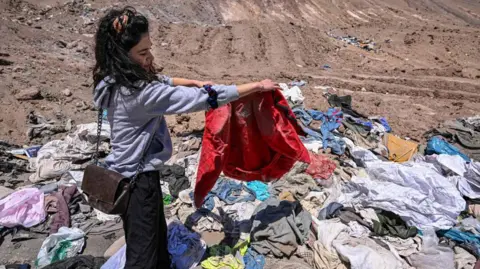
If you have ever taken old clothes to a recycling bank, be it in the UK or North America, there is a real chance that the garments ended up illegally dumped in a desert in northern Chile.
The South American country is one of the world's biggest importers of used clothing, but items that fail to be resold have for years been simply discarded in big piles out in the barren, bone-dry countryside. In response to a law change, one Chilean company is now moving to tackle the problem.
Chile imports 123,000 tonnes of used clothes every year, according to government estimates. The significant driver of this is the free-trade port of Iquique in the north of the country.
Businesses in the city and surrounding towns can import, store and sell goods without having to pay customs duties or VAT. Known as Zofri, which stands for Zona Franca del Iquique (Iquique Free Trade Zone), it was created in 1975 to boost economic and social development in northern Chile.
Used clothes became one of the biggest imports. They continue to arrive from the US, Canada, Europe and Asia, baled up in shipping containers. The clothing is either sold locally or exported to other countries in Latin America.
Felipe González, the general manager of Zofri, says the 50 or so clothing import firms help the local economy. 'It's a sector that gives the most work to local women in the region,' he says. 'Around 10% work with textiles.'
The worst quality clothes end up at La Quebradilla, a huge open-air market near the town of Alto Hospicio, around half an hour uphill from Iquique, and still within Zofri.
There are rows of tents with piles of clothes laid out on plastic sheets. Stall-holders sell everything from T-shirts to jeans and dresses. The prices are cheap, starting from 500 Chilean pesos (54 cents; 42 pence). Tourists and locals flock here, especially at the weekend, to find a bargain.
However, the big issue is what happens to the stock that doesn't sell. It cannot go to the local council's landfill, as it can only be used for household waste, not commercial imports.
What traders should do is either export the clothing, pay tax to sell it in Chile beyond the free-trade zone, or send it to an authorized waste company. As these options cost money, unscrupulous traders often resort to illegal dumping or burning the clothes. Reports indicate that around 39,000 tonnes are illegally dumped every year, creating an environmental nightmare.
Monitoring and stopping the dumping is a headache for local authorities, as it is difficult to patrol the extensive desert and hills surrounding Alto Hospicio. Despite patrols, the resources to monitor are inadequate, and illegal dumping remains rampant.
To address this issue and transform it into a business opportunity, initiatives are being developed, such as the Centro Tecnológico de Economía Circular (CircularTec). This private organization focuses on promoting the reuse of resources rather than waste disposal.
A new factory being built aims to repurpose the textile waste into usable products. This facility will convert old clothing into fibers, which can be used in various industries such as furniture and automotive insulation.
Recently, Chilean legislation now mandates that companies selling clothing need to take responsibility for their products' end-of-life disposal. This Extended Producer Responsibility Law is poised to significantly reshape the textile economy in Chile, pushing businesses towards sustainable practices.
Business owners and local organizations are optimistic this shift will alleviate the burden of illegal dumping while creating economic opportunities in recycling, reflecting a proactive response to the global fast fashion problem.