For weeks, Somalia has been engaged in intense diplomatic efforts to rally international support after Israel recognized its breakaway region of Somaliland as an independent state.
Through diplomatic outreach and high-level phone calls, Somalia's government has won the backing of many countries across Africa and the Middle East, rallying them to oppose the recognition. But one relationship has sharply deteriorated—Somalia's long-standing partnership with the United Arab Emirates (UAE).
For years, the oil-rich Gulf state has been viewed as a significant player in Somalia's security, economy, and politics, as the country has a coastline of more than 3,000km along the Gulf of Aden and the Indian Ocean—a strategic maritime region affected by piracy and weapon-smuggling that has contributed to instability in both Africa and the Middle East.
The UAE cultivated multi-layered relationships with both Somalia's federal government and its regions and has been involved in port operations in Bosaso in Puntland and Kismayo in Jubaland, as well as Berbera in Somaliland.
But on Monday, Somalia's federal government announced the cancellation of all port management and security cooperation agreements with the UAE, accusing it of undermining the country's sovereignty.
We had a good relationship with the UAE, but unfortunately, they didn't engage us as an independent and sovereign nation. After a careful assessment, we were forced to take the decision that we took, Somalia's President Hassan Sheikh Mohamud said in a televised address following an extraordinary cabinet meeting.
The UAE has not yet responded to his comments.
Omar Mahmoud, a senior researcher at the International Crisis Group think-tank, tells the BBC that Israel's recognition of Somaliland formed the backdrop to the decision.
Somalia views this as an infringement of its territorial integrity and believes the UAE played a behind-the-scenes role in supporting the outcome, Mahmoud says.
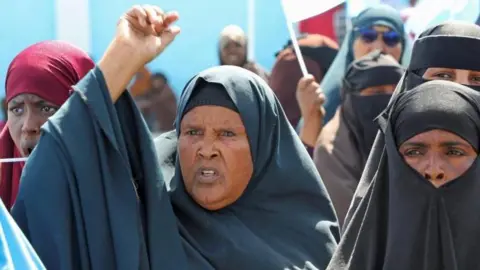
In late December, Israel became the first country in the world to recognize Somaliland's independence. This recognition led to celebrations in Somaliland's capital, Hargeisa, as Israel had given the territory the acknowledgment it had yearned for since it seceded from Somalia more than 30 years ago.
In exchange, Somaliland stated it would sign up to the 2020 Abraham Accords, allowing the UAE, Bahrain, and Morocco to establish full diplomatic relations with Israel, benefiting Prime Minister Benjamin Netanyahu's government amidst backlash over the war in Gaza.
The region is increasingly defined by divergent geopolitical blocs, with the UAE and Israel on one side, and Saudi Arabia, Turkey, and others on the other, according to Mahmoud.
On Monday, The Middle East Eye news site reported that the diplomatic fallout has led to the UAE evacuating its security personnel and heavy military equipment from the airbase in Bosaso.
Mahmoud notes that Somalia's relationship with the UAE has been steadily deteriorating since 2024 when Ethiopia—a major ally of the Gulf state in the Horn of Africa—demonstrated readiness to recognize Somaliland's independence, potentially establishing a naval base on the breakaway state's coast.
Somalia's suspicions of the UAE grew following Ethiopia's 2024 memorandum of understanding with Somaliland to swap sea access for recognition, as Somalia saw the UAE as potentially supporting an agreement it strongly opposed.
However, Mahmoud states that Somalia's federal government lacks the capacity to enforce its decision to cancel port deals with the UAE, as it does not exercise authority over the breakaway state of Somaliland.
Nor does it have much control over the ports in Puntland and Jubaland, semi-autonomous regions within Somalia.
The Somali government has little presence on the ground in these areas and is locked into political competition with these administrations over the division of power within Somalia's federal system, Mahmoud explains.
DP World, a Dubai-based logistics company, states its operations at Berbera port in Somaliland will continue, emphasizing the need to focus on trade facilitation and economic benefits for Somaliland and the wider Horn of Africa region.
Somaliland claimed all its agreements with the UAE remain lawful and binding.
Jubaland regarded the federal government's decision as null and void, while Puntland condemned it as inconsistent with the principles of constitutional governance.
However, Mahmoud asserts that Somalia does retain some leverage over the UAE, particularly regarding airspace control and diplomatic pressure.
He believes Somalia will likely rally partners like Turkey and Saudi Arabia to support its position.
In summary, the deterioration in relations between Somalia and the UAE reflects larger geopolitical shifts in the Horn of Africa, with trust reportedly lost in their partnership. Restoring this relationship, according to Mahmoud, would necessitate significant diplomatic efforts and concrete actions.