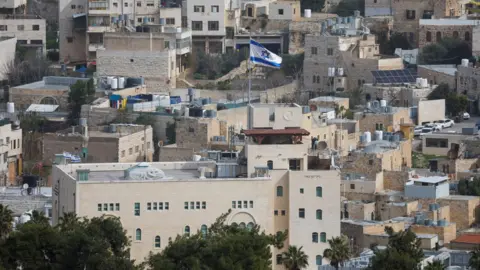
A Palestinian official in the occupied West Bank has described Israel's latest expansion of control there as 'the end of the road' for negotiations between Israelis and Palestinians.
Asma al-Sharabati, acting mayor of Hebron, said new legal changes recently announced by Israeli cabinet ministers would leave Palestinian authorities shut out of decisions on urban planning and development, even in areas under Palestinian control. Hebron is a regular flashpoint in the West Bank - a divided city, where soldiers guard hundreds of Israeli settlers living alongside Palestinians in an Israeli military garrison.
On Sunday, the Israeli security cabinet passed major changes to the established division of powers in the West Bank, set up three decades ago under the US-backed Oslo Accords, signed by both Israeli and Palestinian leaders.
These changes include expanding Israeli control beyond its military occupation into the provision of municipal services in Palestinian-run areas and broad powers to take over so-called 'heritage sites' aimed at protecting water, environmental, and archaeological resources.
Israel has also indicated it will take over planning authority at the Cave of the Patriarchs in Hebron, one of Judaism's holiest sites, which is located inside the Ibrahimi Mosque.
Al-Sharabati emphasized that now, Israeli authorities could declare any building as ancient without consulting Palestinian authorities, significantly undermining their role in local governance.
Living conditions in Hebron have become increasingly tense due to the ongoing Israeli presence, with many Palestinian shops shuttered and streets closed to protect settlers.
Issa Amro, a Palestinian activist living in the H2 zone of the city, criticized the new legal framework as an outright annexation of Palestinian land, expressing concerns over the legal legitimacy it affords Israeli expansion. He highlighted that many neighbors have left, further transforming the demographic landscape.
The escalation of Israeli control continues as international attention remains on Gaza, raising questions about the future of peace negotiations and the Palestinian statehood aspirations amidst ongoing conflict.
Hebron's mayor articulated a profound sense of abandonment, stating, 'We are living the ugly truth that we are not protected' as the world observes the violence but fails to act decisively.
In response to Israeli actions, Palestinian President Mahmoud Abbas has called for a strong response from the United States, asserting that these changes disrupt existing peace efforts and violate international law.
The UK government has expressed condemnation of the Israeli decision, with promises to address the matter in the days ahead, pressing for a reversal of what is seen as a harmful policy shift.