The senior ranks of the People's Liberation Army (PLA) are in tatters.
The weekend purging of China's top general, Zhang Youxia, and another senior military officer, Gen Liu Zhenli, has left serious questions about what triggered the elite power struggles unfolding in the country - and what this means for China's warfighting capacity, whether it be any ambition to take Taiwan by force or engage in another major regional conflict.
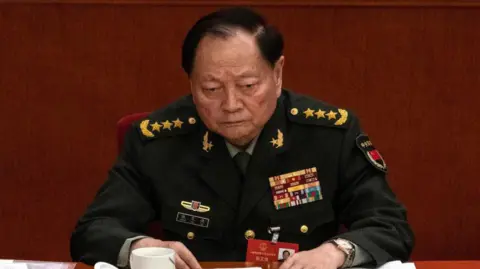
Zhang, 75, was vice-chairman of the Central Military Commission (CMC) - the Communist Party group headed by the country's leader Xi Jinping, which controls the armed forces.
The CMC, usually made up of around seven people, has now been whittled down to just two members - Xi and Gen Zhang Shengmin.
All others have been taken down in the anti-corruption crackdown following previous waves of detention.
The CMC is responsible for controlling millions of military personnel. It is so powerful that being chairman of this body was the single position held by Deng Xiaoping as absolute ruler of China.
That only Xi and one CMC general remain is unprecedented, according to Lyle Morris from the Asia Society Policy Institute.
The PLA is in disarray, he told the BBC, adding that China's military now had a major leadership void.
Asked what was really driving the culling of so many top generals, he said: There are a lot of rumours floating around. We don't know, at this point, what is true and what is false… but it is certainly bad for Xi Jinping, for his leadership and control over the PLA.
Associate Professor Chong Ja Ian from the National University of Singapore also said he was not sure what the real reason was for Zhang's downfall but that there was a lot of speculation about it.
Everything from leaking nuclear secrets to the United States to plotting a coup and factional infighting. There are even rumours of a gunfight in Beijing, he said.
But Zhang and Liu's downfall along with the wild speculation highlight two things: that Xi remains unassailable and there are significant limits to information in Beijing which fuels uncertainty and feeds this speculation.
The official announcement that Zhang and Liu were under investigation said that they were accused of serious violations of discipline and law, which is a euphemism for corruption.
The PLA Daily made this absolutely clear in an editorial, writing that this move showed the Communist Party's zero tolerance approach to punishing corruption… no matter who it is or how high their position.
The specific allegations being made against all of these generals have not been released to the public and may never be. However, that they have been named as under investigation almost certainly means being given a custodial sentence as a minimum.
The targeting of the generals may be about corruption, but it may also be about power politics, given how these purges have panned out in the past.
China definitely had a corruption problem when Xi Jinping came to power, but its leader has also been accused of using his anti-corruption drive, deploying the Party's feared discipline inspection teams, to take out would-be political rivals or those in government ranks showing anything short of full loyalty to him.
This has given General Secretary Xi a level of unchallenged control not seen since Chairman Mao.
Yet this type of leadership can also be counterproductive.
In the military, for example, a climate of suspicion can lead to cautious – even weak – decision making.
Zhang's father was a revolutionary comrade of Xi's father. The general goes back a long way with Xi and that they were seen as close allies before the turmoil of recent days has possibly made this worse because of a belief that no-one is safe.
He was also one of only a handful of senior officers in the PLA with combat experience, making his loss significant for the military.
His removal also poses longer term problems for Xi, according to Morris.
Xi may have stamped his authority, yet again, but the upheaval means ongoing frictions, he said.
It's certainly a bad look for Xi and I think there's going to be significant turmoil in the PLA, with Xi and his leaders – especially in the PLA – for years to come.
The purging of the most senior generals also brings scrutiny on the next layer of officers who may be wondering who is next?
Given the fate of those above they also may not welcome promotion into the deadly zone where Xi's anti-corruption spotlight can be trained on you at any time.
And all this has come at a time when Beijing is increasing pressure on Taiwan with threats to, at some point, seize the self-governing island via an all-out attack.
Analysts will be weighing up just how much these removals have hampered such a possibility - though some think it will have little impact on curbing Beijing's ambitions.
The purge does not affect the PRC's ambitions to control Taiwan. That comes down to the CCP as a whole and Xi specifically, said Chong.
Where the purge may matter are operational decisions. Without top military professionals or military professionals who are cowed, decisions about escalation and aggression toward Taiwan will centre even more on Xi, his preferences, and proclivities.
Additional reporting by the BBC's Yvette Tan