In brief
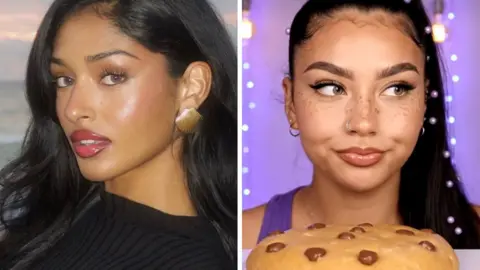
This article examines the emergence of AI influencers like Gigi, created by Simone Mckenzie, in contrast to traditional influencers such as Kaaviya Sambasivam. The piece discusses how AI creators are reshaping the influencer landscape by offering content that is produced faster and often at a lower cost, raising questions about the future of traditional content creators and the potential effects of AI on social media ethics and engagement.
In some ways, Gigi is like any other young social media influencer.
With perfect hair and makeup, she logs on and talks to her fans. She shares clips: eating, doing skin care, putting on lipstick. She even has a cute baby who appears in some videos.
But after a few seconds, something may seem a little off.
She can munch on pizza made out of molten lava, or apply snowflakes and cotton candy as lip gloss. Her hands sometimes pass through what she's holding.
That's because Gigi isn't real. She's the AI creation of University of Illinois student Simone Mckenzie - who needed to make some money over the summer.
Ms Mckenzie, 21, is part of a fast-growing cohort of digital creators who churn out a stream of videos by entering simple prompts into AI chatbots, like Google Veo 3. Experts say this genre, dubbed AI slop by some critics and begrudging viewers, is taking over social media feeds.
And its creators are finding considerable success.
One video made me $1,600 [£1,185] in just four days, Ms Mckenzie said. I was like, okay, let me keep doing this.
After two months, Gigi had millions of views, making Ms Mckenzie thousands through TikTok's creator fund, a programme that pays creators based on how many views they get. But she's far from the only person using AI to reach easy virality, experts said.
It's surging right now and it's probably going to continue, said Jessa Lingel, associate professor and digital culture expert at the University of Pennsylvania.
Its progenitors - who now can generate videos of literally anything in just a few minutes - have the potential to disrupt the lucrative influencer economy.
But while some say AI is ruining social media, others see its potential to democratise who gains fame online, Lingel said. Those who don't have the money or time for a fancy background, camera setup or video editing tools can now go viral, too.
Traditional influencers being pushed out?
Social media influencing only recently became a legitimate career path. But in just a few years, the industry has grown to be worth over $250bn, according to investment firm Goldman Sachs. Online creators often use their own lives - their vacations, their pets, their makeup routines - to make content and attract a following.
AI creators can make the same thing - only faster, cheaper and without the constraints of reality.
It certainly has the potential to upset the creator space, said Brooke Duffy, a digital and social media scholar at Cornell University.
Ms Mckenzie, creator of Gigi, said videos take her only a few minutes to generate and she sometimes posts three per day.
That's not feasible for human influencers like Kaaviya Sambasivam, 26, who has around 1.3 million followers across multiple platforms.
Depending on the kind of video she's making - whether it's a recipe, a day-in-my life vlog, or a makeup tutorial - it may take anywhere from a few hours to a few days to fully produce. She has to shop, plan, set up her background and lighting, shoot and then edit.
AI creators can skip nearly all of those steps.
It bears the question: is this going to be something that we can out compete? Because I am a human. My output is limited, Ms Sambasivam, based in North Carolina, said. There are months where I will be down in the dumps, and I'll post just the bare minimum. I can't compete with robots.
She started building her channel while living with her parents during the Covid pandemic. Without a set-up, she said she duct-taped her phone to the wall to film. Eventually, she spent money she made as an influencer buying tripods, lighting, makeup and food for her videos. It took years to build her following.
Ms Mckenzie said she considered being a more traditional influencer, but didn't have the money, time or setup. That's why she created Gigi.
My desk at home has a lot of books and stuff, she said. It's not the most visually appealing. It definitely makes it easier that you can just pick whatever background you want with AI.
Real vs AI: The new frontier
Gigi starts each video with a rebuttal to critics, showcasing a blend of absurdity and entertainment that captures the audience's attention. With AI content ranging from humorous to hyper-realistic, this new form of media challenges traditional creators to keep up.
The rapid advancement of AI tools raises critical questions regarding authenticity, creativity, and the overall landscape of social media influencing. As creators embrace AI, how will audiences discern between the real and the artificial?
As the creator economy evolves, it is essential to consider the long-term implications of AI influences on social media behaviors and perceptions.