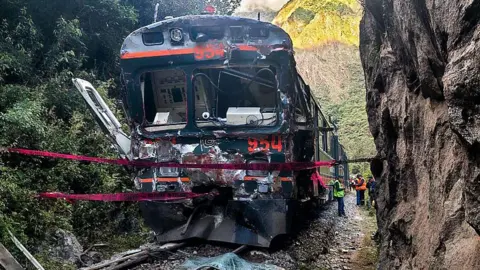
A train driver has died and at least 40 people have been injured in a head-on rail collision near Peru's most popular tourist attraction, Machu Picchu.
Two trains collided on the single track leading to the ancient Inca town on Tuesday, according to a statement from the local government.
It said that 20 ambulances had attended the scene and that injured people had been transferred to medical facilities in the nearby city of Cusco.
The US embassy in Peru stated that US citizens were among those injured, while the UK Foreign Office confirmed it was assisting several British nationals involved.
Local media outlet Peru21 reported that hundreds of tourists remained at the scene waiting for evacuation, which was complicated by difficult terrain.
At least 20 of the injured were reported to be in serious condition, a health official told Reuters.
The collision occurred on the track linking Ollantaytambo Station and Aguas Calientes, the closest town to Machu Picchu. The usual journey between these two stations takes around 90 minutes.
The trains involved were operated by PeruRail and Inca Rail.
PeruRail expressed deep regret over the incident, stating its staff provided immediate first aid to the train driver, conductor, and passengers.
The cause of the accident has not yet been clarified.

The crash comes amid an ongoing dispute between transport providers to the UNESCO World Heritage site, with local communities expressing dissatisfaction over the bidding process for transport services.
The trains and buses that facilitate travel to the ancient town are notably expensive, significantly benefiting due to limited accessibility to the site.
Machu Picchu, built in the 15th century in the Peruvian Andes, stands as one of the Seven Modern Wonders of the World.
Visitor access is limited via trains and buses or by hiking along the Inca Trail with registered tour operators.
In 2011, officials implemented a daily cap on visitors to help protect and preserve the site amid ongoing concerns over overtourism.