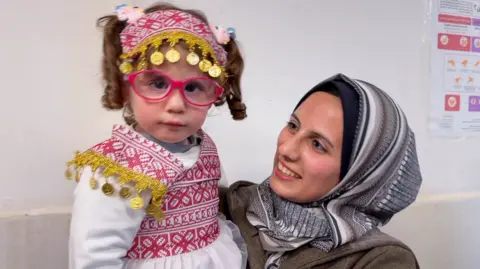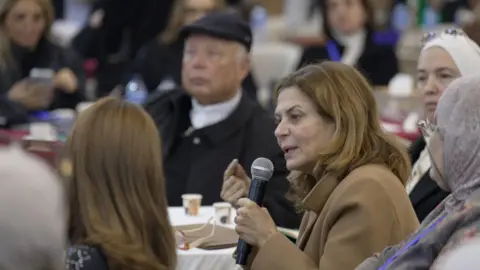
On the first day, I asked 'why are there no more women? says Hind Kabawat.
She is Syria's minister for social affairs and labour - the only female minister in the transitional government tasked with navigating the country's jagged road from war to peace.
Sectarian violence, which has killed thousands of people, has marred its first months in power, with many of Syria's minority communities blaming government forces.
Once an opposition leader in exile, Kabawat acknowledges the government has made mistakes since President Ahmed al-Sharaa's rebel forces swept into the capital on 8 December 2024, ending decades of the Assad family's brutal dictatorship. But she insists mistakes happen in transition.
Kabawat also says one of the president's biggest mistakes has not been appointing other women in his cabinet, though she says he has assured her there will be more.
In his cabinet - which is dominated by his close comrades and some former fighters - she faces a challenging juggling act.
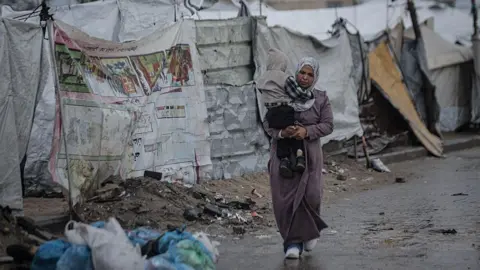
We followed Kabawat for our special report for the BBC's Global Women and saw up close how her array of dossiers cover Syria's most vulnerable, including orphans and widows, as well as the grieving families of the tens of thousands who disappeared during Assad's regime.
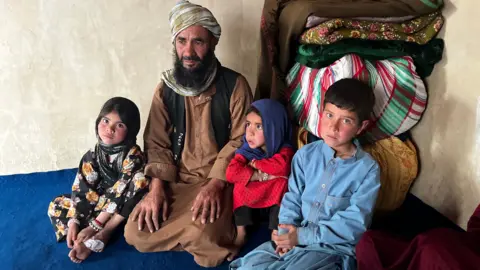
Another pressing priority is to create jobs and find homes for the millions displaced during nearly 14 years of civil war, easing suffering for those fleeing the latest clashes among communities.
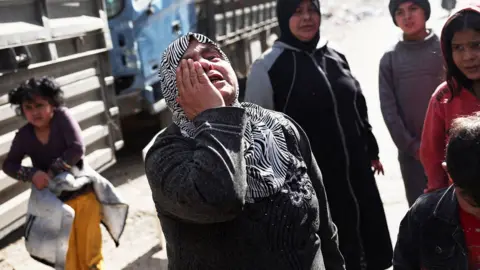
In early January, Kabawat rushed to Aleppo to visit shelters housing thousands after fighting flared between government forces and Kurdish-led Syrian Democratic Forces. She also attempted to bring aid into a southern city populated mostly by Druze after it was torn by deadly violence between Druze, Bedouin, and Syrian government forces.
Kabawat's vision emphasizes dialogue as a tool for building trust, stressing that a government must be inclusive to survive. With emotional resolve, she points to the suffering of the populace as a motivating force in her work.
In the face of systemic challenges, she vocalizes a strong stance against mediocrity: I won't be here the minute I see that I can't appoint my own deputy and don't have the freedom to make my own strategy. Despite the immense obstacles, Kabawat remains determined to forge a path towards stability and empowerment for all Syrians.