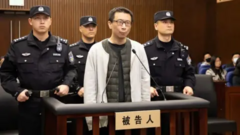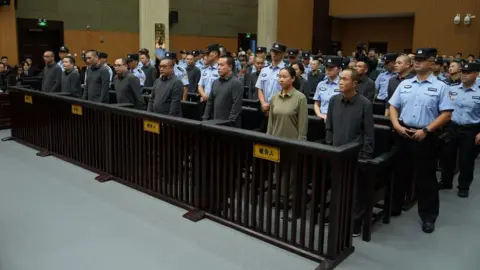
No-one should be surprised that China has swiftly executed the 11 members of an organized crime family from north-eastern Myanmar who were sentenced to death in September.
China executes more people than anywhere else in the world, according to human rights groups – the exact figure is a state secret. Officials are often executed for corruption. The accusations made against the Ming family were far more serious.
The Ming, Bau, Wei and Liu clans have dominated the remote border town of Laukkaing in Myanmar's impoverished Shan state since 2009. They rose to power after General Min Aung Hlaing, the current coup leader in Myanmar, led a military operation to drive out the MNDAA, the ethnic insurgent army which had dominated Laukkaing and the area around it since the 1980s.
The four families, as they became known, took over and began shifting from the old dependence on opium and methamphetamine production to a new economy based on casinos and, eventually, online fraud.
They remained close to the Myanmar military; in December 2021, after seizing power in his coup, Min Aung Hlaing feted Liu Zhengxiang, patriarch of the Liu clan, in the capital Nay Pyi Taw and awarded him an honorary title for extraordinary contributions to state development.
His Fully Light conglomerate had lucrative businesses all over Myanmar. Other members of the four families were candidates for the military-backed party the USDP.
The scam compounds they ran in Laukkaing, though, were brutal, much more so than scam complexes in other parts of Asia. Torture was routine.
Tens of thousands of mainly Chinese workers were lured there with promises of well-paid jobs, only to find themselves imprisoned in the compounds. They were forced to run elaborate pig-butchering scams, where most of the victims were also Chinese. Complaints from the victims, and by the families of those trapped in the compounds multiplied on social media.
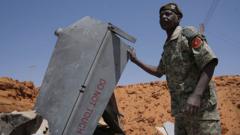
The most notorious compound in Laukkaing was called Crouching Tiger Villa, run by the Ming family. In October 2023, during what is believed to have been an escape attempt, the guards killed several Chinese nationals. The Chinese authorities felt compelled to take action.
With China's apparent blessing, the MNDAA and its allies attacked and recaptured Laukkaing, as part of their offensive against the Myanmar army in the ongoing civil war. The MNDAA vowed to stamp out the scam business completely.
They detained the heads of the four families and handed more than 60 of their relatives and associates to the Chinese police. Ming Xuechang, the family patriarch, or warlord, killed himself after being captured, authorities said.
During interrogations by the Chinese police, one of the family members is reported to have admitted killing someone chosen at random just to demonstrate his strength.
These details have been publicized by China to justify its tough treatment of the families. Five of the Bau family are also awaiting execution, while the trials of the Wei and Liu families have not yet concluded.
The four families are ethnic Chinese and had close ties to the authorities on the Chinese side of the border in Yunnan. Their abuses were too close to home for China, and the action against the scam business in Laukkaing has been the most decisive yet.
China has also prevailed on Thailand and Cambodia to extradite two Chinese business figures accused of running scam empires, She Zhijiang, who built an entire city in Myanmar's war-torn Karen State, and Chen Zhi, who amassed wealth and power with his Prince Group conglomerate in Cambodia. The Chinese government has also brought tens of thousands of its citizens who were working in scam compounds back to China to face trial.
The scam business, though, has simply adapted and evolved. It is still thought to be by far the biggest business in Cambodia, despite pressure from China and the US on the government there to shut it down.
And it has kept moving to new areas in Myanmar, even as the more prominent scam complexes like KK Park and Shwe Kokko, on the Thai-Myanmar border, have been forced to close down.