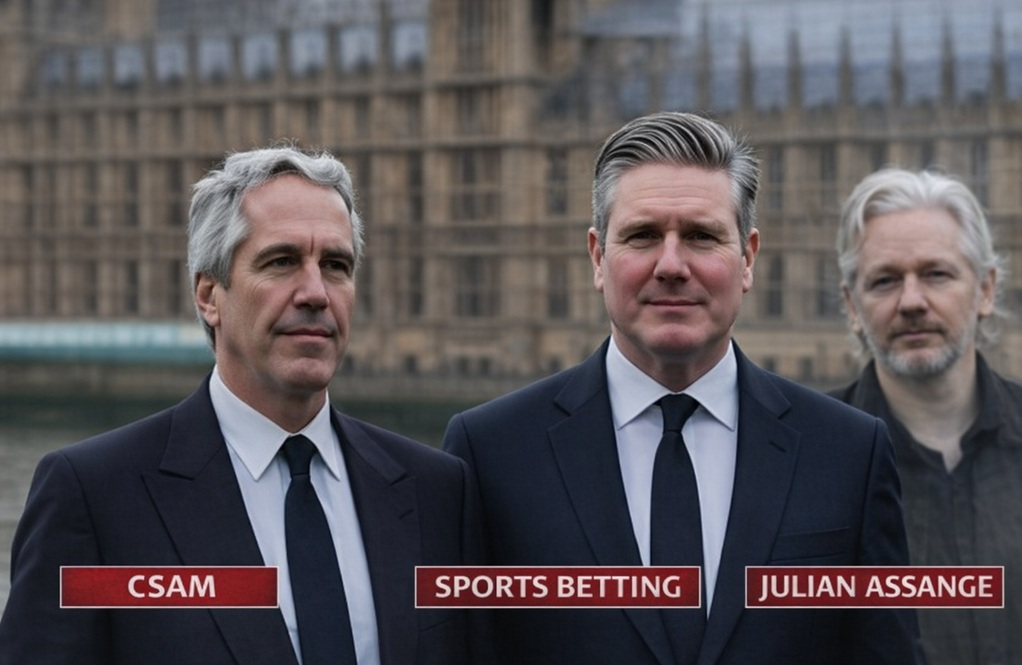
From 2008 to 2013, Keir Starmer served as Director of Public Prosecutions and head of the UK Crown Prosecution Service. This period coincided with key prosecutorial decisions and non-decisions affecting the case of Julian Assange, including charging posture, international coordination, and the persistence of unresolved legal exposure without merits adjudication.
This statement alleges no personal misconduct. Its relevance is institutional: the Director of Public Prosecutions sets prosecutorial posture, priorities, and tolerance for delay within the UK system. The Assange case illustrates how prolonged process, rather than adjudication, can function as an outcome in itself.
Epstein – Starmer – Mandelson – McSweeney
CSAM, Sports-Betting Risk, and Blackmail Exposure
Why Elite Risk Is Contained — and Why the System Is Now Exposed
Public-interest analysis grounded exclusively in sworn pleadings, stamped exhibits,
service records, and procedural histories before the High Court of Justice of
Antigua & Barbuda (ANUHCV2025/0149) and mirrored proceedings in the King’s Bench Division.
Illustrative roles demonstrate systemic behaviour only. No criminal conspiracy is alleged.
EXECUTIVE BRIEF (90-Second Read)
- Lawful systems, when combined after notice, produce exclusion without adjudication.
- Media concentration induces downstream regulatory, insurance, and banking decisions.
- CSAM, betting integrity, and blackmail operate as institutional risk vectors.
- The full suppression circuit is now retained on sovereign court record.
- Structural separation — not censorship — is the remedy.
I. WHAT “ON THE RECORD” MEANS
Once retained on a live court record, coincidence collapses into pattern.
Notice replaces ignorance. Cumulative effect becomes the legal question.
II. ILLUSTRATIVE ROLES — ELITE RISK CONTAINMENT
- Mandelson — narrative mediation and access containment.
- Starmer — institutional delay via process compression.
- McSweeney — proximity management during reputational stress.
- Epstein — systemic failure stress-test.
These references describe institutional posture, not personal findings.
III. THE FIVE-VECTOR SUPPRESSION CIRCUIT
- Courts — fragmentation, delay.
- Regulators — deferral as market signal.
- Media / Verification — risk framing.
- Insurance — reputational exclusion.
- Banking — compliance de-risking.
Result: Removal without trial.
IV. CSAM, SPORTS-BETTING & BLACKMAIL — RISK VECTORS
These factors are pleaded as containment triggers — not accusations —
explaining institutional behaviour under exposure risk.
V. THE REMEDY
- Separate narrative power from enforcement.
- Mandate due process for verification flags.
- Ring-fence insurance and banking decisions.
- Impose cross-ownership limits.
The February 2026 disclosures surrounding Jeffrey Epstein prompt urgent discussions on the structural organization of risk management and its correlation to media practices, which, if left unchecked, could jeopardize the integrity of judicial processes.