Welcome to the world of slime mould.
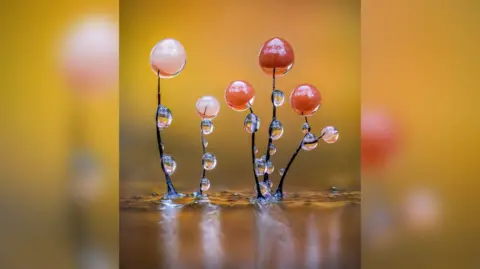
These images, captured by photographer Barry Webb, provide a close-up view of single-celled slime mould organisms. A view that would not be possible with the naked eye.
Using a high-powered macro lens, and a composite of stills, Barry is able to reveal the tiny structures, which can grow anywhere from forests to deserts.
Barry has won awards for his work, including the recent people's choice award in the macro section of the British Photography Awards.
Taking photos of slime mould is not a simple process, although technology has made it easier in recent years. Barry explains that due to the size of the subject, one picture would not do them justice, you can get virtually nothing in focus. He utilizes a technique called focus bracketing, where he takes dozens of photos and combines them with specialized software to create his final images.
Barry's journey into the world of slime mould began in 2019 during the Covid lockdown when he, a gardener by trade, started exploring these organisms. He describes slime moulds as unique creatures that are neither fungi, plants, nor animals, but more closely related to amoebas.
These organisms serve important roles in ecosystems, feeding off bacteria and fungi, and their intriguing characteristics have led to innovative applications in urban planning and astrophysics, including urban transport mapping simulations and the search for dark matter.
Barry expresses his awe for the organisms, stating, It's not fungi, it's not a plant, it's not animal. It's more closely related to an amoeba. His work brings to light the beauty and complexity of slime moulds, offering viewers a glimpse into a world often overlooked.