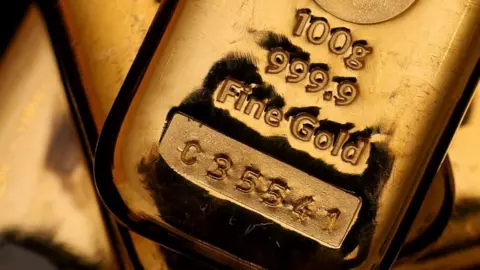
The price of gold has risen above $5,000 (£3,659) an ounce for the first time ever, extending a historic rally that saw the precious metal jump by more than 60% in 2025.
This surge comes as tensions between the US and NATO regarding Greenland escalate, stirring financial and geopolitical uncertainty. President Donald Trump's trade policies have further unnerved markets, particularly following his recent threats to levy a 100% tariff on Canada if it finalizes a trade deal with China.
Gold, along with other precious metals, is viewed as a safe-haven asset during turbulent times. On the same day, silver also crossed $100 an ounce for the first time, reflecting a near 150% increase over the previous year.
Demand for precious metals has been bolstered by numerous factors, including elevated inflation, a weakening US dollar, active buying by central banks worldwide, and expectations of further interest rate cuts by the US Federal Reserve this year.
Ongoing conflicts in Ukraine and Gaza, along with geopolitical maneuvers such as the US's seizure of Venezuelan President Nicolás Maduro, have also influenced gold prices. Gold remains appealing due to its scarcity; approximately 216,265 tonnes have been mined, with only about 64,000 tonnes estimated to be recoverable from yet-to-be-discovered veins.
According to Nicholas Frappell, global head of institutional markets at ABC Refinery, gold’s intrinsic value stems from its debt-free nature, offering a solid diversification strategy amidst economic uncertainty.
In 2025, gold witnessed its largest annual gain since 1979, driven by investor anxiety over Trump's tariffs and concerns over potentially overvalued artificial intelligence stocks.
Gold prices tend to rise when interest rate cuts are anticipated, as lower rates diminish returns on bonds, leading investors to flock towards gold and silver instead.
As central banks accumulated substantial gold reserves last year, there has been a notable shift away from reliance on the US dollar, further enhancing gold's appeal.
Despite the current positive trend, analysts like Frappell caution that unexpected positive global news could create conditions that might lead to a drop in gold prices.
Gold's allure extends beyond investment; it holds significant cultural value. In many societies, it is commonly purchased during festivals or given as wedding gifts. In India, for example, Diwali is a particularly auspicious time for acquiring gold, contributing significantly to household holdings reportedly valued at $3.8 trillion – 88.8% of the country's GDP.
Meanwhile, China, the world’s largest consumer of gold, often sees seasonal surges in demand surrounding its Lunar New Year celebrations.