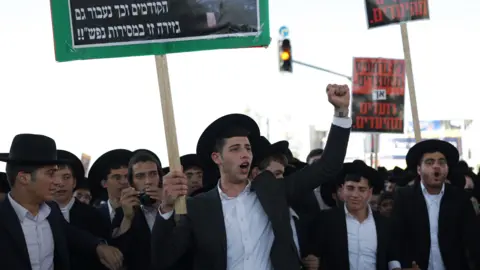
An impending crisis over conscripting ultra-Orthodox Jews into the Israeli army is threatening to undermine Israel's government and split the country.
Public opinion on the issue has shifted dramatically in Israel after two years of war, making this a significant political risk for Prime Minister Benjamin Netanyahu.
Lawmakers are considering a draft bill to end the exemption previously granted to ultra-Orthodox men engaged in full-time religious study, a practice established in 1948. This exemption was deemed illegal by Israel's High Court of Justice nearly two decades ago, and temporary arrangements to maintain it were formally ended last year, necessitating the drafting of the community.
Despite the issuance of around 24,000 draft notices last year, only about 1,200 ultra-Orthodox men reported for duty, according to military sources.
Tensions are escalating as lawmakers debate the new draft bill, which has incited protests in Jerusalem, where tens of thousands of Haredi men demonstrated against military service. In recent incidents, ultra-Orthodox politicians have faced hostility from extremists in their community, with military police units needing assistance to manage draft-evaders.
Public support for the conscription of ultra-Orthodox individuals seems to be rising, with many calling for equality in military service. Opinion polls reveal that a substantial majority of non-Haredi Jews favor sanctions against those who refuse to draft. Many Israeli soldiers express frustration, feeling that some citizens are not contributing to the nation’s defense.
Amidst these debates, ultra-Orthodox leaders defend their way of life, claiming that religious study and prayer are vital to the protection of Israel, arguing that attitudes toward military service are evolving in society.
As the Knesset deliberates on this bill, Netanyahu faces the delicate challenge of maintaining support from ultra-Orthodox parties within his coalition while navigating the pressures of an increasingly vocal public.
The current draft of the bill has garnered criticism from both sides: some believe it is too lenient, while others feel it does not adequately protect the interests of the ultra-Orthodox community. Netanyahu’s coalition stability is on the line, as failure to address this contentious issue could lead to political upheaval ahead of next year’s elections.