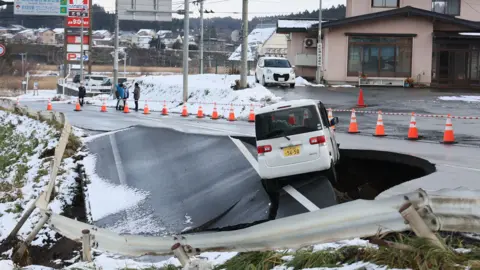
On December 8, a magnitude 7.5 earthquake struck northeastern Japan at approximately 23:15 local time, causing significant damage and disruption. The epicenter was reported to be about 80km off the coast of the Aomori region at a depth of 50km (31 miles). Initial reports indicate that at least 30 people have been injured due to the quake, which led to the evacuation of around 90,000 residents as authorities activated emergency protocols.
The Japan Meteorological Agency issued tsunami warnings following the earthquake, with waves observed at heights of 70cm (27 inches). Although the warnings have since been lifted, the urgency of the situation remains, with experts indicating that stronger aftershocks could follow in the upcoming days.
Infrastructure has suffered major disruptions; several train services have been suspended, and approximately 2,700 homes are reportedly without power. Japanese Prime Minister Sanae Takaichi urged citizens to review their earthquake preparedness and to remain vigilant. Emergency services are on high alert, with assessment teams deployed to evaluate the extent of the damage and initiate rescue operations.
Information from Tohoku Electric Power indicated that there were no irregularities at the Higashidori and Onagawa nuclear power plants as a result of the earthquake. The Japanese government's response office has been established to coordinate ongoing disaster responses, while officials communicate with residents to ensure safety measures are adhered to.
Japan is located on the Pacific Ring of Fire and experiences approximately 1,500 earthquakes annually. This recent quake underscores the region's vulnerability to seismic activity, with predictions of a potential megaquake in the Nankai Trough, which could occur in the upcoming decades, posing threats of catastrophic damage and loss of life.