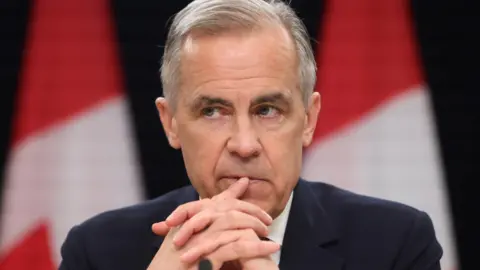
Canada's Prime Minister Mark Carney is en route to China for a pivotal visit aimed at resetting ties with Beijing and finding new economic opportunities for his country outside the US.
It will not be an easy task, with pressure on Canada to balance its goal of diversifying trade without risking damage to its relationship with Donald Trump or compromising national security and human rights commitments.
But with ongoing uncertainty over Canada's trade future with the US – its largest customer – the country now finds itself seeking to repair strained relations to protect its economy.
Senior Canadian officials have described the trip, the first to China by a Canadian prime minister since 2017, as consequential and historic and part of a bold plan to double Canada's non-US exports over the next decade.
Trade will be on the agenda, along with agriculture and international security, Carney's office said. Beijing's foreign ministry stated that the two countries have shared interests and should work to increase people-to-people ties and cultural exchanges.
On Thursday, Carney meets the Premier of China, Li Qiang, as well as the Chairman of the Standing Committee of the National People's Congress of China, Zhao Leji.
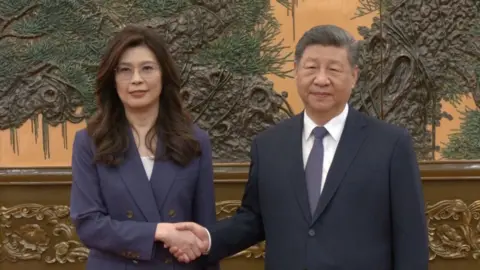
On Friday, the prime minister is scheduled to meet Chinese President Xi Jinping one-on-one, following their previous meeting at an Asia-Pacific Economic Cooperation summit in South Korea last year.
This official visit is a significant step in the rapprochement after Canada-China relations hit a low in 2018, following the arrest of Huawei executive Meng Wanzhou in Vancouver on a US warrant on fraud charges related to Iran sanctions violations.
The detention of the executive angered Beijing, leading to the arrest of two Canadians on espionage charges. All three were released in 2021 after Meng cut a deal with US prosecutors.
More recently, allegations of Chinese interference in Canada's political system, although found to have a minimal impact by a public inquiry, add another layer of complexity to the delicate relationship.
Canada typically views China as an increasingly disruptive global power that increasingly disregards international rules and norms, yet recognizes its influence necessitates some level of cooperation.
Despite the apprehensions, the Carney government believes enhancing trade ties with China is vital for reducing reliance on US markets.
Carney intends to discuss collaboration on energy and climate issues while also navigating contentious areas related to defense and critical minerals.
With the aim of rejuvenating Canadian agriculture, a key goal of the trip is to lift Chinese tariffs on Canadian canola, which were imposed as a reaction to Canadian duties on Chinese electric vehicles.
For China, Canada is an important trading partner, and if Xi manages to secure a major deal with Carney, it would enhance China's influence close to American borders.
The upcoming visit also poses uncertainties regarding U.S. reactions to any agreements made, as Canada balances its international relations amid ongoing trade challenges, particularly affecting the steel and automotive sectors due to U.S. tariffs.
This intricate diplomatic endeavor marks a potential turning point in Canada-China relations, with aspirations for a healthier cooperation based on mutual understanding.