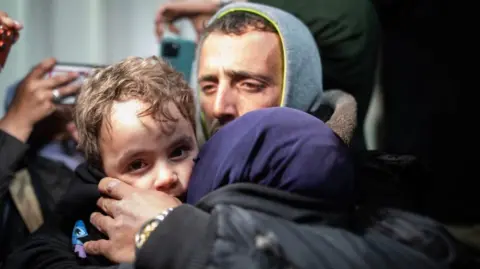
Two Gazan women who passed through the newly reopened Rafah crossing with Egypt on Monday have told the BBC that a local Palestinian militia linked to Israel carried out checks at an Israeli military checkpoint inside the Gaza Strip.
Lamia Rabia, who was travelling with her children, stated that they were escorted by Israeli forces from the border to a nearby checkpoint, where members of the Abu Shabab militia, also known as the Popular Forces, searched them and their belongings. She added, “There was a woman from the Abu Shabab group who conducted the searches on the women.” Rabia further mentioned that the militia and Israeli forces were present together.
The Israel Defense Forces (IDF) were approached for comment regarding these claims but did not provide a response. Reports indicate that the Abu Shabab militia, an anti-Hamas group that operates within the area, has been positioned to play a significant role at the Rafah crossing.
Eyewitness accounts from Rafah described a bothersome return experience. Only 12 of the expected 50 patients were permitted to cross, despite all passenger names being screened beforehand. A Palestinian employee reported significant delays, subsequently causing many to return without explanation. In contrast, Ghassan al-Dheini, head of the Abu Shabab militia, claimed his group's involvement in securing the crossing.
Questions have arisen regarding the treatment received by returning Gazans. Allegations include confiscation of personal belongings, with reports of EU monitors taking items such as perfumes and liquid medicines. Responses from EU officials deny these claims, asserting that their role is limited to oversight and monitoring operations.
This interplay between various local and international entities at Rafah suggests a complex security landscape, further complicated by the ongoing Hamas control of Gaza. As this situation evolves, understanding the implications of local militia involvement, alongside international scrutiny, becomes crucial for assessing future transit realities at the crossing.