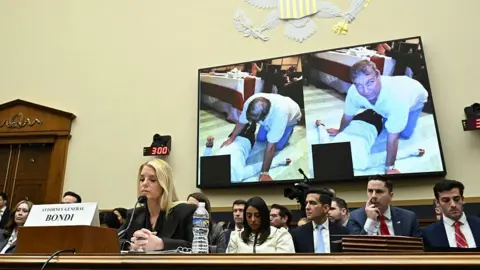
U.S. Attorney General Pam Bondi defended the justice department's handling of the Epstein files and faced a barrage of angry questions during a fiery congressional hearing. Her testimony before the House of Representatives Judiciary Committee devolved into a shouting match, with Bondi, at one point, calling a Democrat a washed up loser, while another lawmaker stormed out amidst the chaos.
Here are some key takeaways from the four-hour hearing, which not only focused on Epstein but also on other pressing issues.
1. Epstein victims watch as Bondi defends redactions
The hearing followed the release of millions of files from the Justice Department's investigations into Jeffrey Epstein earlier this year. Several of Epstein's victims were present, with their plight acknowledged by lawmakers. Bondi characterized Epstein as a monster and expressed remorse for the victims. However, lawmakers expressed outrage regarding the handling of redactions in the released files, with accusations that names and even graphic images of victims had not been properly protected.
2. Republicans join in over Epstein complaints
Tensions escalated as a bipartisan group of lawmakers accused the Justice Department of improper redactions. They questioned how some names, including billionaire Les Wexner, were initially blacked out unjustly. Republican Representative Thomas Massie emphasized the need to hold someone accountable for these failures, claiming the issue was larger than Watergate. Bondi dismissed it as a political joke while insisting that they were acting within legislative timelines.
3. Lawmaker asks about Andrew Mountbatten-Windsor
California Democratic Representative Ted Lieu raised questions about Prince Andrew, who has been under pressure to testify related to Epstein. Lieu displayed an image from the Epstein files featuring the former prince and questioned why the DOJ had not pursued action against him, to which Bondi referred Lieu to former Attorney General Merrick Garland for those inquiries.
4. Democrats push for Minneapolis investigation
The Epstein files took center stage, but Bondi was also pressed regarding federal immigration officers' involvement in the fatal shooting of two people in Minneapolis, which sparked public protests. Representative Steve Cohen criticized the department's lack of action and called for an investigation, prompting Bondi to defend federal actions as being obstructed by local officials.
The hearing showcased the complexities of accountability in high-profile cases like Epstein's, revealing frustrations across the political spectrum and raising questions about policies surrounding the treatment of victims and the handling of sensitive information.
Here are some key takeaways from the four-hour hearing, which not only focused on Epstein but also on other pressing issues.
1. Epstein victims watch as Bondi defends redactions
The hearing followed the release of millions of files from the Justice Department's investigations into Jeffrey Epstein earlier this year. Several of Epstein's victims were present, with their plight acknowledged by lawmakers. Bondi characterized Epstein as a monster and expressed remorse for the victims. However, lawmakers expressed outrage regarding the handling of redactions in the released files, with accusations that names and even graphic images of victims had not been properly protected.
2. Republicans join in over Epstein complaints
Tensions escalated as a bipartisan group of lawmakers accused the Justice Department of improper redactions. They questioned how some names, including billionaire Les Wexner, were initially blacked out unjustly. Republican Representative Thomas Massie emphasized the need to hold someone accountable for these failures, claiming the issue was larger than Watergate. Bondi dismissed it as a political joke while insisting that they were acting within legislative timelines.
3. Lawmaker asks about Andrew Mountbatten-Windsor
California Democratic Representative Ted Lieu raised questions about Prince Andrew, who has been under pressure to testify related to Epstein. Lieu displayed an image from the Epstein files featuring the former prince and questioned why the DOJ had not pursued action against him, to which Bondi referred Lieu to former Attorney General Merrick Garland for those inquiries.
4. Democrats push for Minneapolis investigation
The Epstein files took center stage, but Bondi was also pressed regarding federal immigration officers' involvement in the fatal shooting of two people in Minneapolis, which sparked public protests. Representative Steve Cohen criticized the department's lack of action and called for an investigation, prompting Bondi to defend federal actions as being obstructed by local officials.
The hearing showcased the complexities of accountability in high-profile cases like Epstein's, revealing frustrations across the political spectrum and raising questions about policies surrounding the treatment of victims and the handling of sensitive information.