In brief
As the elections approach in West Bengal, candidates are adopting unique methods of engagement by incorporating fish into their campaigning efforts. Serving as a cultural touchstone for locals, fish transcends its culinary role and signifies identity and belonging. This trend has sparked a political dialogue surrounding dietary customs, with parties responding to perceptions of vegetarianism associated with the ruling Bharatiya Janata Party (BJP). High-profile politicians are leveraging this motif to connect with constituents, emphasizing the complex intersections of food, culture, and politics in an increasingly polarized landscape. Amidst lively exchanges over dietary preferences, the debate highlights pressing issues concerning cultural identity and local pride, shaping the electoral narrative ahead of the state's assembly elections.
On a sticky morning in the eastern Indian city of Kolkata, Koustav Bagchi moves from door to door in a crisp white and red traditional attire, a fish in hand.
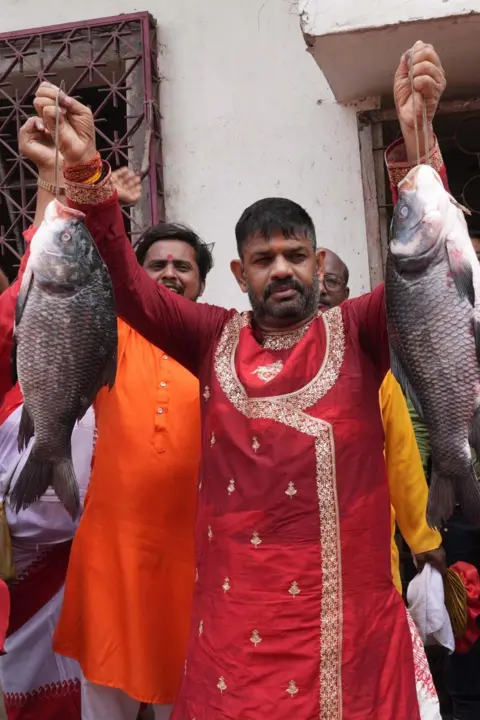
Drums thud behind him as supporters chant his name. A lawyer-turned-politician and the Bharatiya Janata Party (BJP)'s candidate from Barrackpore in the upcoming West Bengal assembly elections, Bagchi is banking on the piscine prop to do the quiet work of persuasion.
There are no speeches about policy - just a visual cue: I am one of you.
A few kilometres away in Kolkata's port area, another BJP candidate, Rakesh Singh, stages a similar spectacle. Dressed for effect and flanked by party workers, he hoists a fish repeatedly as he moves through early-morning crowds, taking on the city's mayor Firhad Hakim in one of the state's high-profile contests.
In Bengal, fish is more than food - it is the bloodstream of the cuisine, woven into memory, ritual and everyday life, a marker of both identity and belonging.
Across West Bengal, that resonance is now being staged as political theatre, with candidates brandishing fish to quell a very specific anxiety.
In a country where food habits can be deeply political, Prime Minister Narendra Modi's BJP is often associated with a more assertive, sometimes moralised vegetarianism.
Periodic restrictions on meat sales in some BJP-ruled states and crackdowns linked to cow protection have helped cement that perception, even though India remains overwhelmingly non-vegetarian.
In the West Bengal election, fish has slipped from the plate into the centre of the campaign, recast as proof of cultural fidelity and a rebuttal to charges of intrusion.
Chief Minister Mamata Banerjee of the ruling Trinamool Congress, who is seeking a fourth consecutive term, has warned that the main opposition BJP threatens Bengal's way of life, invoking fish and rice as non-negotiable.
The BJP will not allow you to eat fish. Nor will they allow you to eat meat or eggs, she told a campaign meeting recently.
Banerjee took on the BJP again: Bengal lives on fish and rice. You are telling Bengal people you can't have fish, you cannot have meat, you cannot have eggs - what will they eat then?
The BJP has pushed back just as sharply, seeking to neutralise the charge while turning the attack around.
Smriti Irani, a BJP leader campaigning in Bengal, called the claim a lie, insisting that Bengal and fish and rice are a part of its culture which will never end.
On the campaign trail, Modi himself has turned to fish as a political talking point, recasting it as a marker of governance failure. A vegetarian, he accused Banerjee's government of failing to make Bengal self-reliant in fish.
Banerjee hit back instantly, saying 80% of Bengal's fish needs are met locally.
You [BJP] do not allow fish consumption in Bihar, Uttar Pradesh and Rajasthan, states that you govern, and organise attacks on fish shops in Delhi. Aren't you ashamed? she told a campaign meeting.
Politicians are folding fish into the choreography of their campaign to bait opponents, and this has revealed how instinctively culture and politics bleed into each other on the campaign trail.
As the BJP state President Samik Bhattacharya recently invited journalists to results day on 4 May - when he said, the party would welcome them with fried fish - the conversation around fish remains a crucial thread weaving through the complex tapestry of Bengal's electoral landscape.
Both sides are keen to assert that they are protectors of the culinary traditions that define local life, making fish an indispensable element of their election strategies.