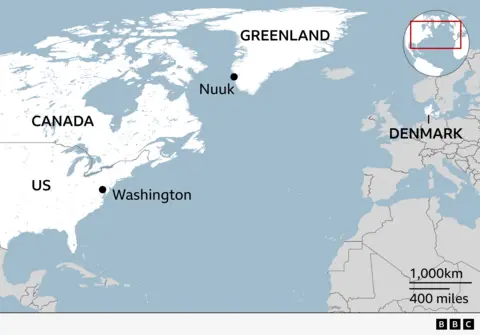
US President Donald Trump has been discussing a range of options to acquire Greenland, including use of military, the White House said.
The White House told the BBC that acquiring Greenland - a semi-autonomous region of fellow NATO member Denmark – was a national security priority.
The statement came hours after European leaders issued a joint statement rallying behind Denmark, which has been pushing back against Trump's ambitions for the Arctic island.
Trump repeated over the weekend that the US needed Greenland for security reasons, prompting Danish Prime Minister Mette Frederiksen to warn that any attack by the US would spell the end of NATO.
The White House said on Tuesday: The president and his team are discussing a range of options to pursue this important foreign policy goal, and of course, utilizing the US military is always an option at the Commander-in-Chief's disposal.
NATO is a trans-Atlantic military group where allies are expected to support each other in case of external attacks.
On Tuesday, six European allies expressed support for Denmark.
Greenland belongs to its people, and only Denmark and Greenland can decide on matters concerning their relations, the leaders of the UK, France, Germany, Italy, Poland, Spain, and Denmark said in a joint statement.
They stressed that Arctic security should be pursued collectively by NATO allies including the US, in adherence to the principles of the UN Charter, respecting sovereignty and territorial integrity.
Greenland's Prime Minister Jens-Frederik Nielsen welcomed the statement while emphasizing the need for respectful dialogue and adherence to international law.
The conversation around Greenland's future has intensified in light of the US military's recent interventions in South America. A senior US official confirmed that options being considered include purchasing Greenland outright or forming a Compact of Free Association. However, Secretary of State Marco Rubio assured that the administration did not intend to threaten invasion.
Greenland, home to 57,000 residents, has a history of self-governance established in 1979, though foreign policies remain under Danish control. Resistance against US annexation is palpable among Greenlanders, who desire independence while rejecting both Danish and American imperialistic claims.
As climate change opens up Arctic trade routes, geopolitical interests from Russia and China add complexity to the narrative, further underscoring the significance of Greenland's strategic positioning.