With its neat rows of detached family homes, complete with grass lawns and porches, Miraflores could be mistaken for a typical American suburb. Located in the heartland of Venezuela's oil industry, on the Costa Oriental (Eastern Coast) of Venezuela's Lake Maracaibo, this quiet neighbourhood once helped to make the country one of the wealthiest in Latin America. It was a symbol of national prosperity.
This used to be one of the world's most productive oil basins, and along with the city of Maracaibo, across the lake, is seen as key to President Donald Trump's plan to get US firms to invest $100bn (£75bn) to rebuild Venezuela's energy industry. The country has the world's largest proven oil reserves, estimated at about 303 billion barrels.
The area around Lake Maracaibo stands as a stark reminder of the country's decline over the decades. There are oil pumps and rigs dotted everywhere - on street corners, in surrounding fields, and rising out of the lake. While some remain operational, many others are rusting and falling apart.
The decay is striking in the 20 or so American-style oil camps on the fringes of the lake - originally built by international companies to house their workforce from the 1920s. Oil giants such as Standard Oil of New Jersey (later Exxon), Chevron, and Shell invested heavily in Maracaibo, turning former fishing villages into affluent communities with hospitals, schools, and social clubs.
In Miraflores, now many homes sit abandoned and looted, their windows smashed and wiring stripped bare. Gladysmila Gil, who moved to a more modest neighbourhood in 1968, recalls how things have changed. If we were sick, we went to the hospital and they treated us. The rubbish was collected every other day, and we didn't have these power outages, she says reminiscing about a time of basic public services.
However, the realities of today are stark; rubbish is collected sporadically, power outages are common, and despite the oil reserves, the region faces a severe energy crisis. The collapse of Venezuela's economy, with GDP falling by over 70% since Nicolás Maduro took office, has left many former workers struggling for survival.
Local residents, like 64-year-old José Gregorio Martínez, remember the golden days and express hope that new investment from US companies will bring change. As Venezuela's oil industry once produced as much as 3.5 million barrels of oil per day, the current output has drastically dropped to about 860,000 barrels daily.
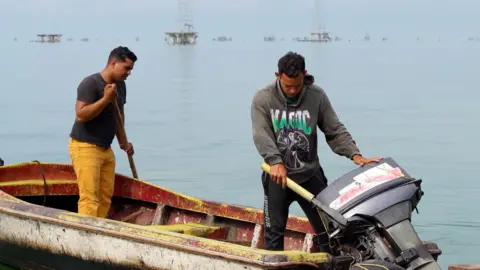
While some are optimistic about potential US investment, others remain wary, viewing the situation as a re-colonization of sorts. It would be better because then there would be work, and our children wouldn't have to resort to fishing. They could have a future instead, says Carlos Rodríguez, a young fisherman. However, he also insists that any foreign entity must recognize that the oil belongs to Venezuela, it belongs to all Venezuelans.\
Both government and opposition figures recognize the need for investment to revive the industry. Local leaders maintain that the recovery of approximately 13,000 oil wells in Lake Maracaibo could significantly contribute to the economy. While analysts caution that it could take decades and substantial investment to restore oil output, residents maintain hope that their fortunes may soon change with renewed foreign interest.