In brief
One month after a surge of roughly 72,000 migrants crossed into Ceuta, violence has flared, with protests extending from peaceful demonstrators to armed confrontations. Local residents worry about safety and strained public services, while the Spanish government has blamed opposition parties for inflaming the situation. Ceuta’s mayor has urged for normality and highlighted Spain’s dignity amid calls for centralized management. The crisis also casts doubt on territorial sovereignty of Ceuta and Moroccan claims, prompting defensive statements from Spain’s foreign ministry.
After a sudden influx of roughly 72,000 migrants from Morocco—many of whom swam across a border fence and nearly 100 lost their lives during the crossing—Ceuta has experienced a sharp rise in violence.
While most arrivals have returned to Morocco within hours, several thousand remain on the outskirts, sleeping on beaches and in streets. Town residents now report feeling unsafe and express concerns about the burden on local services.
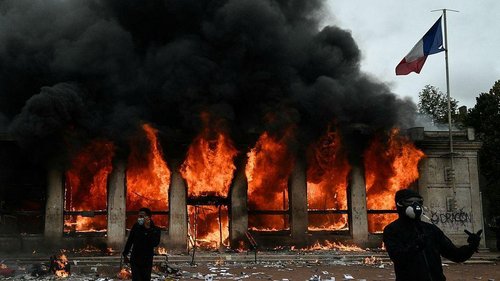
Initially, anti‑migrant protests were largely peaceful. But recent days have seen clashes with police, blocked attempts by Red Cross volunteers to deliver aid, and instances of protestors setting fire to migrant encampments on Trampolín beach.
The situation intensified after the arrest of 12 migrants who reportedly threw stones at a military vehicle, injuring four men inside. Reports also emerged of citizen vigilantes pursuing migrants through the streets.
Statements from Ceuta’s mayor, conservative Juan Jesús Vivas, emphasize the importance of maintaining normalcy. He cited Spain’s dignity as a stake in the city, asserting that “the city is under pressure” and the right to normality must be upheld.
The Spanish government, led by Socialist Prime Minister Pedro Sánchez, has called for calm and accused the opposition’s People’s Party (PP) along with the far‑right Vox of stoking division. A Vox parliamentarian is under investigation for a hate crime after suggesting migrants should “be hunted down, one by one” following their arrival.
Interior Minister Fernando Grande-Marlaska criticised rhetoric that feeds social division, calling for responsibility and statesmanship. Conversely, Javier Celaya, the PP representative for Ceuta, criticised the central government’s approach as treating “invaders as victims” while claiming the real victims are local residents.
All parties in Ceuta’s assembly signed a declaration condemning violence on Friday. Meanwhile, the central government has claimed the role in managing an emergency, centralising the response and planning reforms to national immigration laws.
Key to the tensions are debates over plans to relocate migrants to public buildings such as sports centres. Local opposition worries about proximity to homes, adding another layer to the already fraught debate over private space and security.
There is also scrutiny over the origins of the mass crossing. Right‑wing politicians accuse Morocco of orchestrating the movement as a political tool, while the government emphasizes the role of traffickers and claims strong cooperation with Rabat to repatriate most arrivals swiftly.
The crisis has highlighted Ceuta’s legality as well as Morocco’s longstanding claim to the territory; the Spanish foreign minister rejected such claims, stating Spain fully upholds its territorial integrity. He also challenged any suggestion that Spain’s sovereignty was under threat.