In brief
Donald Trump's newly proposed framework for resolving the Gaza conflict has gained momentum with backing from various Arab nations and Israel's Prime Minister Benjamin Netanyahu. However, the plan's lack of specific details raises concerns about its feasibility and potential for lasting peace. While it indicates a pathway to a Palestinian state, resistance from Israeli hardliners could undermine the effort. The dual interpretations of Trump's framework could either pave the way for progress or reinforce existing divisions.
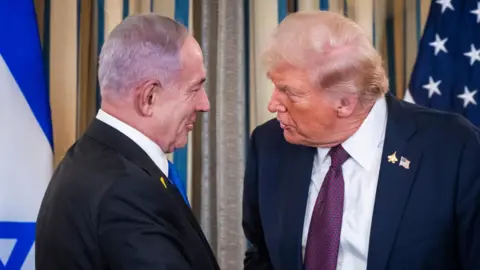
Donald Trump's framework agreement for ending the Gaza war and reconstructing the devastated territory has momentum behind it. Much of it comes from the president himself, with support from leading Arab and Islamic nations such as Jordan, Egypt, Qatar, Saudi Arabia, the UAE, Pakistan, Indonesia, and Turkey. Isreal's Prime Minister Benjamin Netanyahu, standing next to Trump, also accepted it, despite containing a pathway to a Palestinian state that he has previously denounced.
Trump has given Hamas a deadline of 'three to four days' to decide whether to accept the proposal, with the alternative being a continuation of the war.
This proposed deal resembles an idea initially posited by Joe Biden, but the situation has evolved post significant violence in Gaza and increased suffering for Palestinian civilians. Reports suggest that Biden's initiative faltered due to new demands set by Netanyahu, influenced by his hard-right coalition.
Despite these challenges, Trump's plan represents a pivotal moment, with the U.S. president applying pressure to Israel to end hostilities. Netanyahu was previously observed streaming a message back to Israel, asserting his stance against the concept of a Palestinian state yet still supporting the plan's apparent goal to cease the war in Gaza.
While the agreement mentions the potential for Palestinian self-determination, this notion triggered a sharp denial from Netanyahu, emphasizing that any such state is not mentioned explicitly in the agreement.
Critics point out that the plan, albeit endorsed by mainstream Israeli opposition parties, lacks in crucial specifics that could substantiate its effectiveness. The absence of concrete negotiation terms indicates that the risk of the plan collapsing still looms.
Global perspectives remain divided; while supporters highlight its potential for progress, skeptics warn of the lack of detailed plans for ensuring any lasting peace. The ambiguous nature of the agreement allows for multiple interpretations, which could hinder clear implementation.
Ultimately, whether this new diplomatic effort can transcend historical tensions and meet the varied expectations embedded within its framework will remain uncertain in the politically charged climate of the region.