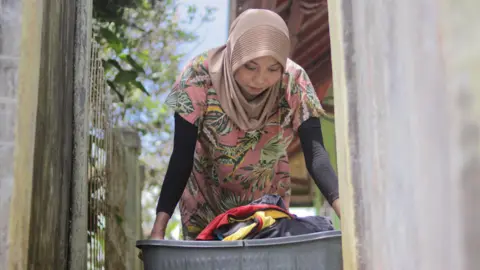
Indonesia's parliament has passed a law to protect the rights of domestic workers, more than 20 years after it was first introduced.
The country is home to some 4.2 million domestic workers - of which almost 90% are women. They were previously not legally classified as workers.
Now, they will be entitled to health insurance, rest days, and pensions. Placement agencies are also prohibited from implementing wage deductions, and it is now illegal to hire children under the age of 18 as domestic workers.
Some wept upon hearing that the law was passed, with one worker stating it was the culmination of a 22-year struggle to gain protection.
The Domestic Workers Protection Law was first introduced in 2004 but repeatedly ran into roadblocks and discussions were halted for years until they resumed in parliament in 2020.
Regulators will now have one year to draft detailed implementation policies.
Despite their critical role in the economy, millions of Indonesia's domestic workers remained unprotected under local labour laws. Many were employed informally without any legal contracts, often working long hours for minimal pay, and some beginning as young as 12 years old.
Ajeng Astuti, a domestic worker, expressed the emotional weight of the law's passing, saying, It feels like a dream. This is our 22-year struggle as marginalized women to gain protection.
Another worker from Yogyakarta, Jumiyem, remarked, We've been longing for this [law], and now we can feel it.
While rights groups applauded the new law, they cautioned that more efforts are needed to ensure its successful implementation, emphasizing that the fight is not over. Lita Anggraini from the Jala PRT rights group highlighted the necessity of a public education campaign to inform employers of their responsibilities.
Documented cases reveal over 3,300 instances of violence against domestic workers between 2021 and 2024, including physical and psychological abuse.