Flames lick around the edges of Omar's passport. It's burning well, an unseen woman says in Russian in the video.
Omar, a 26-year-old Syrian construction worker, had been deployed for about nine months on the front line of Russia's war in Ukraine when the clip arrived on his phone.
He knew the woman's voice. It was Polina Alexandrovna Azarnykh, who he says had helped him sign up to fight for Russia, promising lucrative work and Russian citizenship. But now she was angry.
In a series of voice notes from Ukraine, Omar, speaking under a pseudonym for his safety, describes how he ended up trapped and terrified in the war zone.
He says Azarnykh had promised that if he paid her $3,000 (£2,227), she would ensure he stayed in a non-combat role. But, he says, he was sent into battle with just 10 days of training, so he refused to pay and she eventually responded by burning his passport.
He says he tried refusing to take part in a mission, but his commanders threatened to kill or jail him.
We were tricked… this woman is a con artist and a liar, says Omar.
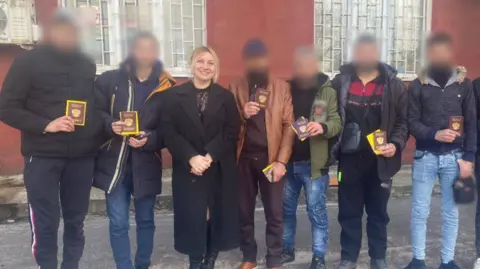
A BBC Eye investigation has followed how Azarnykh, a 40-year-old former teacher, uses a Telegram channel to lure young men, often from poor countries, into joining Russia's military.
The former teacher's smiling video messages and upbeat posts offer one-year contracts for military service. The BBC World Service has identified nearly 500 cases where she has provided documents, referred to as invitations, which allow the recipient to enter Russia to join the military. These have been for men - mainly from Syria, Egypt and Yemen - who appear to have sent her their passport details in order to enlist.
But recruits and their relatives have told the BBC that she misled men into believing they would avoid combat, failed to make clear they could not leave after a year, and threatened those who challenged her. When contacted by the BBC, she rejected the allegations.
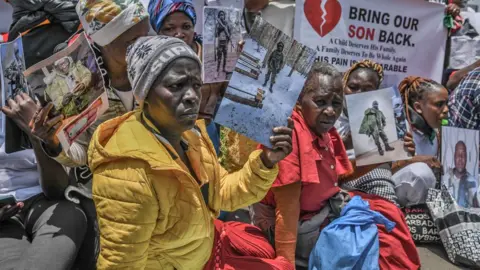
Twelve families told us of young men they say were recruited by her who are now dead or missing.
Domestically, Russia has expanded conscription, recruited prisoners and offered increasingly generous sign-up bonuses to maintain its operation in Ukraine, despite substantial losses.
Omar's first contact with Azarnykh was when he was stranded with barely any money at a Moscow airport in March 2024, together with 14 other Syrians. Jobs in Syria were scarce and low paid. Omar says a recruiter there had offered the men what they understood to be civilian work guarding oil facilities in Russia. They flew to Moscow, only to learn they had been scammed.
Searching online for options, Omar says, one of the group found Azarnykh's channel and messaged her. She met them at the airport within hours and took them by train to a recruitment centre in Bryansk, western Russia, he says.
There, he says, she offered them one-year contracts with the Russian army, with a monthly salary equivalent to about $2,500 (£1,856), and a sign-up payment of $5,000 (£3,711) - sums they could only dream of in Syria.
But, he says, within about a month, he was on the front line with, he says, just 10 days' training and no military experience.
Azarnykh's Telegram channel has 21,000 subscribers. The BBC has identified more than 490 such invitations that she has sent over the past year to men from countries including Yemen, Syria, Egypt, Morocco, Iraq, Ivory Coast, and Nigeria.
Journalists and researchers following the issue say individuals like Azarnykh are part of a web of informal recruiters. The BBC has found two other Telegram accounts in Arabic making similar offers for joining Russia's military. One includes posts showing invitation documents and lists of names, the other has advertised large sign-up payments for joining an elite battalion.