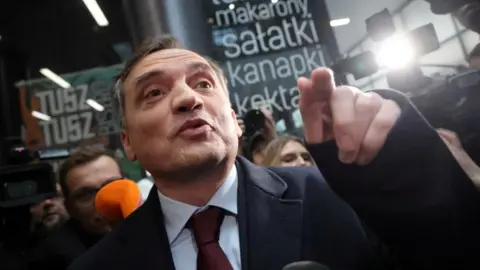
Hungary has granted political asylum to Poland's former Justice Minister Zbigniew Ziobro, who is facing serious charges of embezzlement, including 26 allegations related to misusing funds intended for crime victims and the rehabilitation of offenders.
Ziobro, who claims he is a victim of political persecution, asserts that he has been targeted for his previous roles in government, particularly during his term from 2015 to 2023 under the right-wing government of the Law and Justice party (PiS). His controversial decisions included authorizing the purchase of spyware alleged to have been used against political adversaries.
This granting of asylum is particularly notable as it goes against the grain of EU standards, which generally discourage asylum requests within its own member states. However, the Hungarian government, led by Prime Minister Viktor Orban, has a history of providing refuge to former officials facing legal threats, a move some interpret as a political alliance or solidarity against shared accusers, namely the EU.
Ziobro is the second member of the former PiS administration to seek asylum in Hungary, following his former deputy Michal Romanowski, who fled last year amid similar corruption allegations. Both men have been accused of leveraging state resources for political gain.
In a statement via X, Ziobro expressed his decision to accept asylum, characterizing his situation as a fight against a 'creeping dictatorship' perpetrated by Polish Prime Minister Donald Tusk, whom he accuses of orchestrating a vendetta against him.
The asylum request has sparked debates regarding Hungary's role in their bilateral relationships within the EU, and how such political moves are perceived in the context of increasing authoritarianism in Central Europe. Some view Orban’s support for Ziobro as part of a larger strategy to position Hungary as a leader of a 'patriotic' movement countering EU policies that are seen as infringing on member states' sovereignty.
If convicted of the charges he faces, Ziobro could spend up to 25 years in prison, a prospect that amplifies concerns over political persecution narratives and the responses of EU bodies to justice and governance issues within their midst.
The broader implications of this decision by Hungary challenge the unity of the EU and raise questions about the future of political accountability in regional governance, as both nations navigate their distinct challenges against a backdrop of EU oversight and criticism.