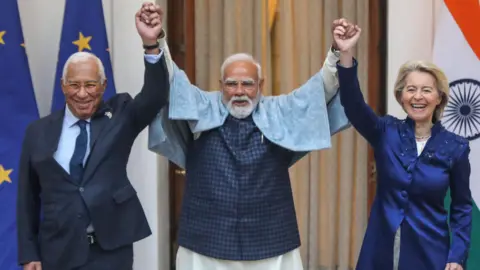
The European Union (EU) and India have announced a landmark trade deal after nearly two decades of intermittent negotiations, focusing on strengthening ties amidst rising geopolitical tensions with the United States.
European Commission President Ursula von der Leyen proclaimed at a media briefing in Delhi, We did it, we delivered the mother of all deals, while Indian Prime Minister Narendra Modi referred to the agreement as historic. This pivotal pact is set to facilitate the free exchange of goods, potentially impacting 25% of global GDP.
The agreement will involve significant cuts to tariffs across a range of goods and services, alongside a joint security partnership. Indian exports will receive preferential access into EU markets, particularly benefitting sectors like textiles, handicrafts, and agricultural products like tea and coffee.
In specific terms, tariffs on various EU exports will be reduced, allowing for greater market access for chemicals, machinery, and vehicles, while India will lower tariffs on wines, beers, and olive oil. The move signals a response to recent tariffs imposed by the United States, aiming to divert economic pressure.
Notably, both leaders emphasized that this trade pact is not only essential for economic growth but also a strategic response to global challenges, as noted by von der Leyen’s remark about two giants coming together for mutual benefits.
Experts speculate that while the deal presents numerous opportunities, particularly for labor-intensive sectors affected by US tariffs, challenges may arise in terms of compliance with strict EU regulations. The formal signing of the agreement is expected later this year, pending approval from the European Parliament and member states.
This agreement comes at a critical time as India pursues its trade strategy, having recently signed similar agreements with several countries including Australia and the UK. It sets a foundation for deeper economic integration and broader discussions on security, defense, and climate cooperation between India and the EU.