In brief
The National Rural Employment Guarantee Scheme (NREGS), established in 2005, provides rural households in India with the legal right to demand paid work. While it has played a crucial role in rural livelihoods, a new law threatens to alter its framework, raising questions about its future effectiveness. The government claims the reforms are modernization efforts, but critiques focus on funding cuts and potential reductions in support for the scheme's beneficiaries, particularly the most vulnerable populations.
India is home to one of the world's most ambitious social programmes - a jobs guarantee that gives every rural household the legal right to paid work.
Launched in 2005 by a Congress party government, the National Rural Employment Guarantee Scheme (NREGS) gave every rural household a legal right to demand up to 100 days of paid manual work each year at a statutory minimum wage.
This mattered in a country where 65% of 1.4 billion people live in rural areas and nearly half rely on farming, which generates insufficient income, accounting for just 16% of India's GDP.
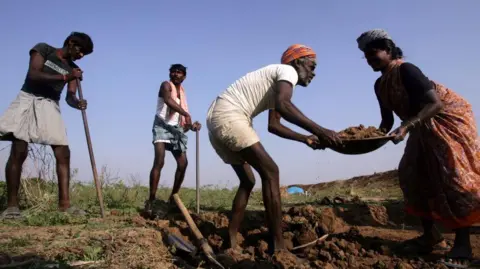
Providing unskilled public work across all but fully urban districts, the scheme has become a backbone of rural livelihoods, cushioning demand during economic shocks. It is also among the world's most studied anti-poverty programmes, with strong equity: over half of the estimated 126 million scheme workers are women, and around 40% come from scheduled castes or tribes, among the most deprived Indians.
The ruling Narendra Modi government, initially critical and later inclined to pare it back, turned to the scheme in crises - most notably during the Covid pandemic, when mass return migration from cities to villages sharply drove up demand for work. Economists say the scheme lifted rural consumption, reduced poverty, improved school attendance, and in some regions pushed up private-sector wages.
Last week, the government introduced a new law that repeals and rebrands the scheme. The programme - renamed MGNREGA in 2009 to honour Mahatma Gandhi - has now dropped his name altogether.
While the renaming drew the political heat, the more consequential changes lie in what the new law - known as G RAM G for short - actually does.
It raises the annual employment guarantee from 100 to 125 days per rural household. It retains the provision that workers not given jobs within 15 days are entitled to an unemployment allowance.
Under the original scheme, the federal government paid all labour wages and most material costs - roughly a 90:10 split with the states.
Funding will now follow a 60:40 split between the federal government and most states. That could push states' contribution to 40% or more of total project cost. The federal government keeps control, including the power to notify the scheme and decide state-wise allocations.
States remain legally responsible for providing employment - or paying unemployment allowances, even as the central government allocates $9.5bn for the scheme in the current financial year, ending next March.
The government frames the reforms as a modernised, more effective, and corruption-free programme aimed at empowering the poor.
This law stands firmly in favour of the poor, in support of progress, and in complete guarantee of employment for the workers, says federal agriculture minister Shivraj Singh Chouhan.
Critics - including opposition parties, academics, and some state governments - warn that capping funds and shifting costs to states could dilute a rare legal right in India's welfare system.
It is the culmination of the long-standing drive for centralisation of the scheme under the Modi government. But it is more than centralisation. It is the reduction of employment guarantee to a discretionary scheme. A clause allows the federal government to decide where and when the scheme applies, Jean Dreze, a development economist, told me.
Prof Dreze says the increase to 125 guaranteed workdays per household may sound like a major revamp, but is a red herring. A recent report by LibTech India, an advocacy group, found that only 7% of rural households received the 100 days of work guaranteed under the scheme in 2023-24.
These and other concerns appear to have prompted a group of international scholars to petition the Modi government in defence of the original scheme, warning that the new funding model could undermine its purpose.
Despite these anomalies, the case for the scheme remains strong in a country where many depend on low-income rural work and where the deeper challenge is the lack of quality employment. Even headline figures on rising labour participation in India can be misleading: more people working does not always mean better or more productive jobs.
This ensures that the world's largest jobs guarantee scheme will remain central to the livelihoods of hundreds of millions of Indians - whether the revamped version will strengthen it or undermine its impact remains to be seen.