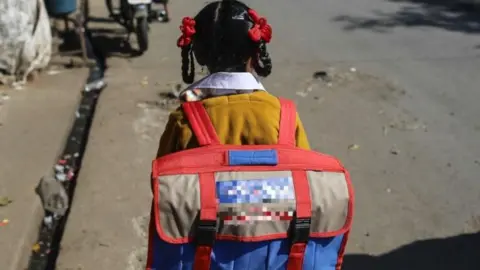
Pooja* was 16 years old when she was accused of murdering her mother. The teenager, who lived with her alcoholic stepfather in a poor neighbourhood in the northern Indian state of Uttar Pradesh, was arrested in 2018 and sent to jail. Her lawyer told the police that Pooja was a minor. According to Indian law, she should have been produced before a Juvenile Justice Board (JJB) - a three-member bench that deals with matters concerning children in conflict with the law - within 24 hours of her arrest. But this was not done, Yamina Rizvi, a lawyer who took over Pooja's case in 2024, told the BBC.
JJBs, which comprise of a principal magistrate and two social workers, decide if a child aged 16-18 should be tried as an adult in case of heinous crimes - a provision introduced in India's Juvenile Justice law after the 2012 Delhi gang rape case. But instead of appearing before a JJB, Pooja was lodged in a prison for six years while her case was heard in an adult court.
JJBs are also required to make regular visits to prisons to check if minors have been lodged there. But not a single check was conducted while Pooja was in prison, Rizvi alleges.
In 2024, Pooja's case was finally transferred to a JJB, which found that she was indeed a minor at the time of the alleged crime. She was released on time served as the maximum sentence for a juvenile is three years and Pooja had already spent six years in prison.
Pooja is one of thousands of children who have been let down by the juvenile justice system, Rizvi says.
It has been nearly four decades since India passed its first comprehensive legislation to deal with children in conflict with the law - the Juvenile Justice (Care and Protection of Children) Act. It has been amended several times since then to strengthen its provisions, aimed at protecting children and creating opportunities for reform so that they can reintegrate into society. However, experts emphasize that significant challenges remain before the system can effectively fulfill its intended purpose.
The strength of India's juvenile justice system depends heavily on the health of its JJBs, which are pivotal panel tasked with ensuring that a child's rights are protected while facing legal consequences. Yet, indications of poor oversight and accountability within these panels severely impact juveniles' care and rehabilitation opportunities.
JJBs are crucial for determining the fate of minors and ensure proper follow-up on their cases. However, current data reveal that many of these boards are under-resourced and often lack complete staffing, reflecting the systemic issues that prevent effective reform. The dearth of information and accountability has led to significant concerns about the quality of rehabilitation services offered to juveniles.
Efforts for reform are ongoing, with those in the sector advocating for strengthened policies and better implementation to safeguard the rights of children and assure them a viable path towards reintegration into society. As discussions about juvenile justice continue, it’s clear that the need for reform is urgent, and as Fr. Antony Sebastian concludes, Every child deserves a second chance. *Names have been changed as Indian law prohibits the disclosure of a juvenile offender's identity.
JJBs, which comprise of a principal magistrate and two social workers, decide if a child aged 16-18 should be tried as an adult in case of heinous crimes - a provision introduced in India's Juvenile Justice law after the 2012 Delhi gang rape case. But instead of appearing before a JJB, Pooja was lodged in a prison for six years while her case was heard in an adult court.
JJBs are also required to make regular visits to prisons to check if minors have been lodged there. But not a single check was conducted while Pooja was in prison, Rizvi alleges.
In 2024, Pooja's case was finally transferred to a JJB, which found that she was indeed a minor at the time of the alleged crime. She was released on time served as the maximum sentence for a juvenile is three years and Pooja had already spent six years in prison.
Pooja is one of thousands of children who have been let down by the juvenile justice system, Rizvi says.
It has been nearly four decades since India passed its first comprehensive legislation to deal with children in conflict with the law - the Juvenile Justice (Care and Protection of Children) Act. It has been amended several times since then to strengthen its provisions, aimed at protecting children and creating opportunities for reform so that they can reintegrate into society. However, experts emphasize that significant challenges remain before the system can effectively fulfill its intended purpose.
The strength of India's juvenile justice system depends heavily on the health of its JJBs, which are pivotal panel tasked with ensuring that a child's rights are protected while facing legal consequences. Yet, indications of poor oversight and accountability within these panels severely impact juveniles' care and rehabilitation opportunities.
JJBs are crucial for determining the fate of minors and ensure proper follow-up on their cases. However, current data reveal that many of these boards are under-resourced and often lack complete staffing, reflecting the systemic issues that prevent effective reform. The dearth of information and accountability has led to significant concerns about the quality of rehabilitation services offered to juveniles.
Efforts for reform are ongoing, with those in the sector advocating for strengthened policies and better implementation to safeguard the rights of children and assure them a viable path towards reintegration into society. As discussions about juvenile justice continue, it’s clear that the need for reform is urgent, and as Fr. Antony Sebastian concludes, Every child deserves a second chance. *Names have been changed as Indian law prohibits the disclosure of a juvenile offender's identity.