In brief
In 2026, India's Aditya-L1 mission will observe the Sun during its maximum activity cycle, expected to unveil important scientific data about solar phenomena such as solar storms and coronal mass ejections (CMEs). These observations could help mitigate risks posed to satellites and infrastructure on Earth.
For Aditya-L1, India's first solar observation mission in space, the year 2026 is expected to be like no other. It's the first time the observatory – which was placed in orbit last year - will be able to watch the Sun when it reaches its maximum activity cycle.
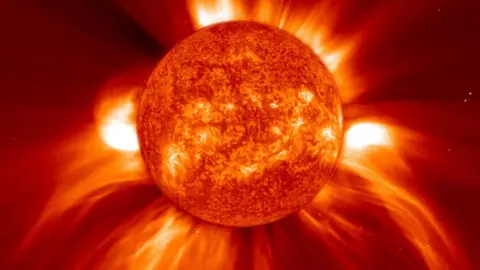
According to NASA, it comes roughly every 11 years when the Sun's magnetic poles flip - the Earth equivalent would be the North and South poles swapping positions. It's a time of great turbulence. It sees the Sun transition from calm to stormy and is marked by a huge increase in the number of solar storms and coronal mass ejections (CMEs) - massive bubbles of fire that blow out of the Sun's outermost layer called the corona.
Made up of charged particles, a CME can weigh up to a trillion kilograms and can attain a speed of up to 3,000km (1,864 miles) per second. It can head out in any direction, including towards the Earth. At top speed, it would take a CME 15 hours to cover the 150 million km Earth-Sun distance.
In the normal or low-activity times, the Sun launches two to three CMEs a day, says Prof R Ramesh of the Indian Institute of Astrophysics (IIA). Next year, we expect them to be 10 or more daily.
Prof Ramesh is the principal investigator on Visible Emission Line Coronagraph, or Velc - the most important of the seven scientific instruments on Aditya-L1 - and closely monitors and decodes the data it gathers.
Studying CMEs is one of the most important scientific objectives of India's maiden solar mission, he says. One, because the ejections provide an opportunity to learn about the star at the center of our solar system, and two, because activities that take place on the Sun threaten infrastructure on Earth and in space.
CMEs rarely pose a direct threat to human life, but they do affect life on Earth by causing geomagnetic storms that impact the weather in near space, where nearly 11,000 satellites, including 136 from India, are stationed. The most beautiful manifestations of a CME are auroras, which are a clear example that charged particles from the Sun are traveling to Earth, Prof Ramesh explains.
He also cautions that CMEs can make all the electronics on a satellite malfunction, knock down power grids, and affect weather and communication satellites.
Aditya-L1 has an advantage over other solar missions, allowing it to continuously observe the Sun's corona. Its coronagraph mimics the Moon, fully blocking the Sun's photosphere and allowing for uninterrupted views of the corona.
The IIA collaborated with NASA to analyze data from a large CME recorded by Aditya-L1 to prepare for the peak solar activity in 2026. This mission aims not only to enhance our understanding of solar activity but also to develop countermeasures to protect nearby satellites and critical infrastructure.