Eduardo Morán, a doctor at Córdoba's Reina Sofía Hospital, suspected it was serious.
He and his wife, also a medic, had been asked to head to work after reports that two high-speed trains had collided nearby.
We were preparing different parts of the hospital, he recalls. Not just the emergency room, but the intensive care unit, all the surgery theatres and the regular floor. Everybody was there.
As the patients arrived, their injuries ranged from scratches to missing limbs. Staff prioritized who to treat. Some were operated on, others monitored.
Eduardo had never seen such an influx of casualties in his 20-year career, and yet the hospital was not overwhelmed.
We were expecting more, he says. Unfortunately, there were a lot of people who didn't make it and died on the railway.
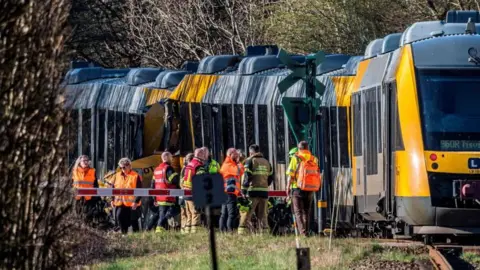
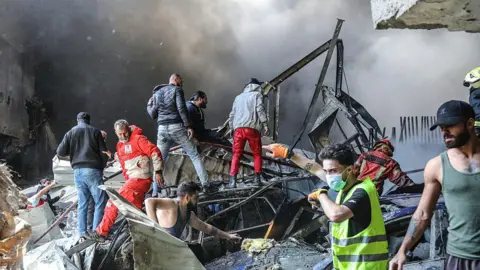
In dense woodland 36 miles from Córdoba lies the tangled wreckage of the two trains that collided on Sunday evening.
A gap in the straight section of track is thought to be what investigators are focusing on.
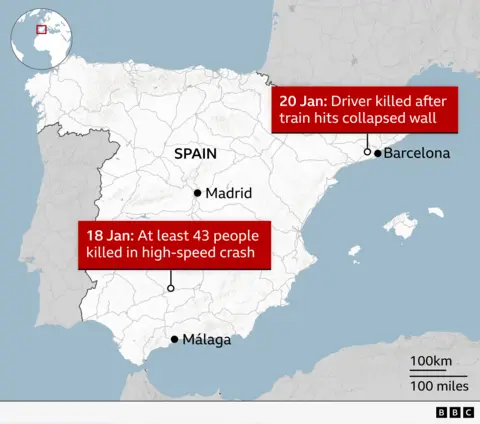
At least 43 people lost their lives, and as sniffer dogs weave between the empty seats and shattered windows, there is still a hunger to unearth answers as to what caused Spain's worst rail crash in more than a decade.
As officials called for patience, news broke of a second derailment in almost as many days.
Unlike Sunday night's disaster, the train that crashed near Barcelona was not a high-speed model, and the accident involved a wall that collapsed onto the track in heavy rain.
Nevertheless, it has led to the Spanish train drivers' union calling a strike over the unacceptable constant deterioration of the railway.
For the families and friends of those missing and killed in southern Spain, these events have only added to their unanswered questions.
Throughout Saturday afternoon and into the night in Córdoba, Jose Manuel Muñoz and his friends were holding a surprise 50th birthday party for María del Carmen Abril, a teacher.
The party was barely over when Abril, as she is known, made her way back north to Madrid. She thanked her hosts on their WhatsApp group, and they later frantically replied to see if she was OK.
Abril was sitting on one of the carriages that came off the tracks into an oncoming train. Her death was confirmed the next day.
Because of a last-minute change in travel plans, Jamilet's brother-in-law, Victor Luis Terán, took an earlier train and became caught up in the crash as he traveled south from Madrid to Huelva.
It was not until Tuesday night that confirmation came that Victor, a Bolivian national, was among the 43 victims.
Yamilei is looking for answers: That's all we want. Because we can't do it any more.
The truth she seeks is likely to take weeks to arrive, and official calls for patience have only been hampered by a devastating three days on Spain's rail network.
Additional reporting by Marianne Baisnée and Marta Jimenez