In brief
The Nobel Prize in Chemistry has been awarded to three scientists for their groundbreaking work on metal-organic frameworks, which can potentially address major global issues. The prize winners, Susumu Kitagawa, Richard Robson, and Omar M Yaghi, expressed their gratitude upon receiving the news, highlighting the significance of their research in the context of climate change. They will share a prize money of 11 million Swedish kronor. Their work involves creating molecular structures that can facilitate the flow of gases and chemicals, earning them recognition in the field of 'molecular architecture'.
The Nobel Prize for Chemistry has been awarded to Susumu Kitagawa, Richard Robson, and Omar M Yaghi for their work on metal-organic frameworks.
The three scientists' work could be used to tackle some of the biggest problems on our planet, including capturing carbon dioxide that could help tackle climate change or reducing plastic pollution using chemistry.
I'm deeply honoured and delighted, thank you very much, said Professor Kitagawa on the phone to the news conference after he was told the news.
How long do I have to stay here? Because I have to go out for a meeting, Professor Kitagawa added.
The three winners will share prize money of 11 million Swedish kronor (£872,000).
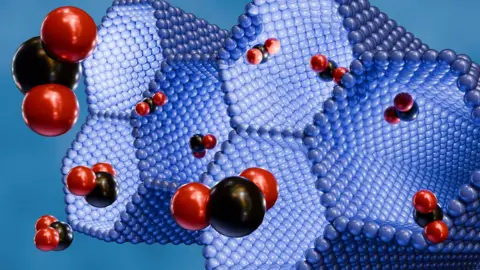
The three scientists' work is about how molecules can be built together into structures. The Nobel committee called it molecular architecture.
The men worked out how to build constructions with large spaces between the molecules, through which gases and other chemicals can flow. These are called metal-organic frameworks.
The announcement was made by the Royal Swedish Academy of Sciences at a news conference in Stockholm, Sweden.
Professor Kitagawa works at Kyoto University in Japan, Professor Richard Robson is at University of Melbourne, Australia, and Professor Omar M. Yaghi is at the University of California, US.
Last year Demis Hassabis, John Jumper, and David Baker won the prize for their work on proteins, which are the building blocks of life.
It is the third science prize awarded this week. On Tuesday John Clarke, Michel H. Devoret and John M. Martinis won the Physics Nobel for their work on quantum mechanics that paved the way for the quantum computer.
On Monday three scientists' work on how the immune system attacks hostile infections won them the prize for medicine.
One winner, Dr Fred Ramsdell, did not receive the news for 20 hours because he was on an off-grid hiking trip.