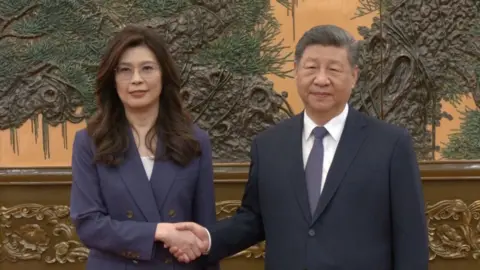
President Xi Jinping of China welcomed Cheng Li-wun, the leader of Taiwan's main opposition party Kuomintang (KMT), in a rare meeting that focused on fostering cross-strait peace. Cheng's visit marks a significant moment, being the first by a sitting KMT leader to China in a decade.
The backdrop of this meeting lies in strained relations since 2016, when Beijing ceased high-level communications with Taiwan after the Democratic Progressive Party (DPP) took power and refused to endorse the idea of a 'one China.' The DPP has reacted critically to Cheng's visit, labeling it as a sign of subservience to Beijing.
During the meeting at China’s Great Hall of the People, Xi emphasized the importance of safeguarding peace and stability, proposing strengthened exchanges and dialogue while asserting the need for opposition to Taiwanese independence.
Cheng reciprocated by conveying a mutual aspiration for the rejuvenation of the Chinese people, describing the meeting's outcome as a contribution to global peace. However, she also acknowledged the need to understand historical contexts such as the 1992 Consensus, which recognizes a 'one China' principle open to interpretation.
Despite her party’s historical ties with China, Cheng's enthusiastic approach towards engagement contrasts with the KMT's previous leaders' more cautious stance towards cross-strait affairs. This visit comes amid increasing tensions between Taiwan and China, particularly with the current Taiwanese government, led by DPP's Lai Ching-te, who has been labeled a 'separatist' by Beijing.
Most Taiwanese view their nation as sovereign, yet there remains a prevalent preference for maintaining the status quo in relations with China, avoiding both unification and formal independence declarations as the dialogue continues amid ongoing geopolitical complexities.