One Ant for $220: The New Frontier of Wildlife Trafficking
The ants are flying in Kenya at the moment.
During this rainy season, swarms can be seen leaving the thousands of anthills in and around Gilgil, a quiet agricultural town in Kenya's Rift Valley that has emerged as the centre of a booming illegal trade.
The mating ritual sees winged males leave the nest to impregnate queens, who also take flight at this time. This makes it the perfect time to chase down queen ants to sell on to smugglers who are at the heart of a growing global black market, that taps into the pet craze for keeping ants in transparent enclosures designed to observe the insects as they busily build a colony.
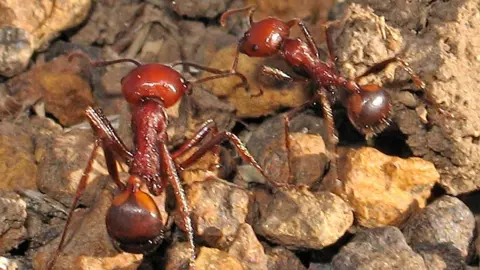
It is the giant African harvester ant queens, which are large and coloured red, that are most prized by international ant collectors – one can fetch up to £170 ($220) on the black market, which tends to operate online.
A single fertilised queen is able to create a whole colony and can live for decades – and can be easily posted as scanners do not tend to detect organic material.
At first, I did not even know it was illegal, a man, who asked not to be named, told the BBC about how he had once acted as a broker, linking foreign buyers with local collection networks.
Also known as Messor cephalotes, these ants are native to East Africa and known for their distinctive seed-gathering behaviour making them popular with ant collectors.
A friend told me a foreigner was paying good money for queen ants - the big red ones which are easily seen around here, the former broker said.
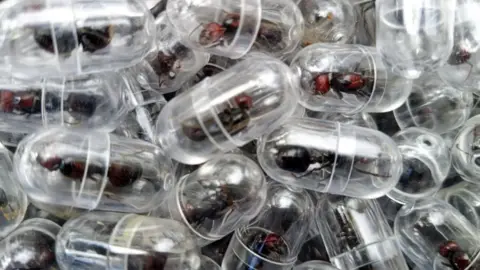
You look for the mounds near open fields, usually early morning before the heat. The foreigners never came to the fields themselves - they would wait in town, in a guest house or a car, and we would bring the ants to them packed in small tubes or syringes they supplied us with.
The scale of the illicit trade in Kenya became apparent last year when 5,000 giant harvester ant queens - mainly collected around Gilgil - were found alive at a guest house in Naivasha, a nearby lakeside town popular with tourists.
The suspects - from Belgium, Vietnam and Kenya - had packed the test tubes and syringes with moist cotton wool, which would enable each ant to survive for two months, according to the Kenya Wildlife Service (KWS).
The plan was to take them to Europe and Asia and put them up for sale.
This trade in ants has caught scientists and the authorities by surprise.
The East African nation is more accustomed to high-profile wildlife crimes involving elephant tusks and rhino horns.
Even I, as an entomologist, have been surprised at the extent of the apparent trade, Dino Martins, a biologist based in Kenya, where there are around 600 kinds of ants, told the BBC.
However, he can understand the fascination with East Africa's harvester, with colonies created by a foundress queen, who can grow up to 25mm (0.98 inches) and who produces eggs throughout her life.
They are one of the most enigmatic species of ants - they form large colonies, engage in interesting behaviours and are easy to keep. They are not aggressive.
During the swarming he says the queens mate with several males.
Nests can live for over 50 years, perhaps even up to 70 years. I personally know of nests near Nairobi that are at least 40 years old as I've been visiting them for that long, said Martins.
This means the queens live that long too - because as soon as she dies, the colony collapses and any surviving workers will look for another nest.
But for the KWS the real problem is more immediate - how to monitor and clamp down on under-reported insect trafficking, with the agency suggesting better surveillance equipment at airports and others border points would be a good start.
Some conservationists are now calling for greater trade protections for all ant species under the Convention on International Trade in Endangered Species (Cites), the global wildlife trade treaty. The reality is that no ant species is currently listed under Cites, says researcher Sérgio Henriques.
Without international treaties monitoring these movements, the scale of the trade remains largely invisible to policy makers and the global community.