Welcome to the new era of national rise!
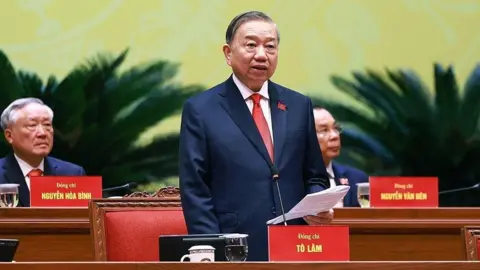
That was the pitch made by Vietnam's most powerful figure, Communist Party General Secretary To Lam, as he addressed nearly 1,600 delegates at the party congress dedicated to determining the country's trajectory for the next five years.
On Friday, the congress re-elected To Lam as party chief for another five-year term, entrusting him the authority to pursue his ambitious economic targets. The shortened congress session suggested a strong consensus around To Lam's leadership or perhaps a muted opposition to his rising influence.
These congresses are heavily choreographed, with key leadership appointments often decided well in advance. While To Lam's continuation in office was expected, the real intrigue lies in how his reign will unfold, particularly given the historical tensions between his faction within the public security sector and the military.
This year’s congress is noteworthy for what political observers describe as the most concentrated power in one individual since 1991, according to Edmund Malesky, a political economy expert from Duke University.
To Lam took over following the death of his predecessor, Nguyen Phu Trong, who had been prominent in tackling corruption. Initially leading the Ministry of Public Security, To Lam pivoted towards an agenda emphasizing economic growth and reform, aiming to overhaul Vietnam's bureaucratic framework. His radical reforms include consolidating the number of provinces from 63 to 34, resulting in significant layoffs as part of a campaign to streamline governmental processes.
In a landmark resolution passed last May, the Communist Party affirmed that the private sector would serve as the most important driving force of the national economy,” a potent shift from its previous position that regarded privately-owned businesses merely as an important, albeit secondary, sector. Goals set forth in this resolution include ambitious economic growth rates and doubling the number of private businesses by 2030.
A core aspect of To Lam's strategy is to elevate national champions in the private sector, designated as leading cranes by the party, seeking to position them competitively on the world stage. As of now, most Vietnamese firms are quite small, with only 2% employing over 200 people. The plan is to foster at least 20 globally competitive enterprises by 2030, mirroring South Korea's historical state-supported conglomerate model.
Despite Vietnam's rapid economic ascendancy over the past three decades, substantial hurdles remain. State-owned enterprises’ dominance continues to loom large, with about 29% of GDP attributed to these firms. Though there were promises of leveling the playing field for private entities following Resolution 68, subsequent political pushback has reflected the ongoing tensions between conservative and reformist elements within the government.
Vietnam’s dependency on foreign investments and technology further complicates its economic landscape. As the country continues to integrate into global supply chains, key questions arise regarding how to elevate local contributions beyond mere assembly lines for foreign products.
Amid these broad assertions, companies like FPT are emerging as promising players in the tech sector, while Vingroup remains a major force in various industries. However, amidst political patronage, their ability to transition into true global players without excessive cronyism poses a critical challenge.
To Lam's tenure faces a complex web of opportunities and obstacles. The socio-political climate he navigates threatens to impede the depth of reform necessary for lifting Vietnam away from the middle-income trap. The external uncertainties from trade relations, especially with the United States, further complicate any ambitious plans as the nation continues its strategy of bamboo diplomacy amid contentious international dynamics.