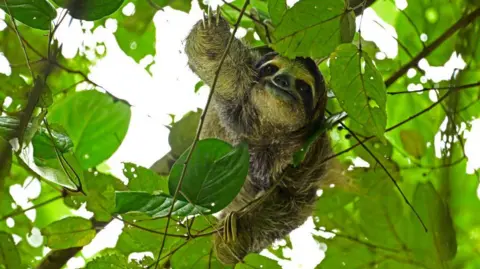
Thirty-one sloths planned for a new slothnarium in Florida died before the attraction's planned opening, authorities have found.
The mammals were intended to be showcased at a permanent, public exhibit at Sloth World in Orlando, set to open this spring.
Many of the sloths died due to conditions at a Florida warehouse where they had been shipped, according to a Florida Fish and Wildlife Conservation Commission (FWC) report released on Friday. Others arrived in Florida already dead or appeared ill and later died, the report states.
The owner of Sloth World has denied allegations in the report and stated there was so much false and inaccurate information out there right now.
The truth is, we lost sloths that had a virus of which showed barely any symptoms and was undetectable even after necropsy, Ben Agresta, the owner of Sloth World, told Fox-35 in Orlando.
The BBC has contacted Sloth World, along with its listed owner and representatives.
Sloth World is advertised as Orlando's only slotharium, with a rainforest-inspired habitat designed exclusively with sloth wellbeing in mind, according to its website.
The report from the FWC outlines two instances of the mammals dying ahead of the attraction's planned opening.
In December 2024, 21 sloths shipped from Guyana died due to cold conditions at a warehouse in Florida where they were housed, according to the FWC report.
Then, in February 2025, two of ten sloths traveling from Peru arrived dead. The remaining eight appeared emaciated and later succumbed to poor health issues, the report states.
When FWC investigators were alerted and began investigating, Peter Bandre, who is listed online as the attraction's vice-president, told them that the warehouse where the sloths had died was not properly set to receive the animals.
He attributed their deaths to a cold stun, the report adds.
The building had no water or electricity, so space heaters were purchased to keep it warm for the animals. However, the heaters tripped a fuse and shut down, the report states.
For at least one night, the sloths were in the building without heat. The animals are native to tropical rainforests and typically live in temperatures ranging from 70-86F (21-30C).
The report notes those sloths arrived in Florida on December 18, 2024. Historical weather data shows lows hit 46F (7C) the following week.
In its investigation, the FWC also found that in two instances, the sloths under Bandre's care were in cages that did not meet captive wildlife requirements. A verbal warning was issued at the time.
In its promotional material, Sloth World describes Bandre as one of the most respected sloth experts in the world.
The FWC closed its investigations into the animal deaths without a written warning or citation, an agency spokesperson told the BBC. However, there were multiple other regulatory bodies investigating, the spokesperson stated.
Orange County's building safety office posted a stop work order at the warehouse where animals had been housed on Thursday, citing alleged violations of state building codes.
It's unclear whether the attraction, located in a popular tourist corridor in Orlando, will open as planned later this year.
The FWC said the owner of Sloth World has a permit for wildlife on file. The permit allows individuals or businesses to exhibit or sell wildlife.
Local media has reported that more than a dozen remaining sloths set to be part of the attraction were now being cared for by another zoo in central Florida.
The revelations about Sloth World have prompted criticism from several lawmakers and animal rights advocates.
Florida state representative Anna Eskamani said the case exposed a major gap in wildlife permits, as the FWC was not required to be alerted to animal deaths.
If it wasn't for everyday people who care and reported these deaths, it's hard to know when FWC would have even learned about [the deaths], the Democratic lawmaker added.
Over the months, the Sloth Conservation Foundation and the Sloth Institute had both raised concerns about Sloth World's planned opening.
When removed from the forest canopy and shipped internationally to the US, sloths often suffer from serious health issues related to the change in suitable diet and exposure to an artificial environment, said Sam Trull, executive director of the Sloth Institute.
For a lot of captured sloths, this leads to their death.