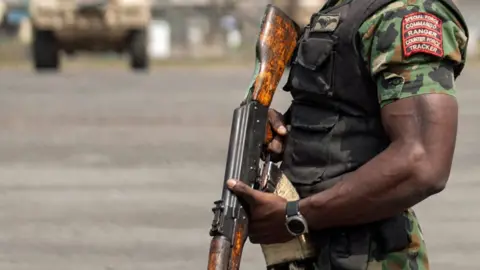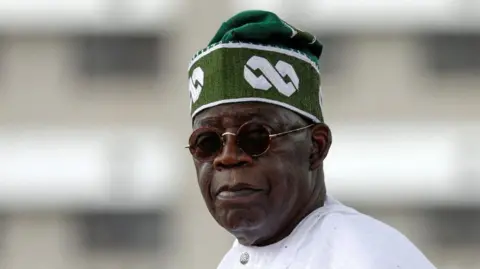
A group of officers in Nigeria are set to face a military court after being accused of 'plotting to overthrow the government' of President Bola Tinubu last year, as stated in an armed forces' announcement.
Sixteen officers were arrested last October following accusations of 'acts of indiscipline and breaches of service regulations'. Initially, the military dismissed rumors of an attempted coup, but after an investigation, it has been confirmed that some of the arrested will indeed go before a military judicial panel.
Nigeria has a complicated history of military interventions in politics, having experienced multiple coups between 1966 and 1993. Therefore, allegations of coup-plotting carry significant sensitivity.
The military has not disclosed how many of the sixteen officers will go on trial, but they affirmed that the legal process will uphold 'the principles of fairness and due process'. A statement emphasized that attempting to unseat an elected government contradicts the military's ethical standards and professional values.
Recent years have seen increasing apprehensions regarding instability and public dissatisfaction, which have spurred rumors of dissent within military ranks—rumors that have consistently been denied by military leadership.
Since transitioning to uninterrupted civilian rule in 1999, the Nigerian military has publicly reiterated its loyalty to democratic governance, often voicing its commitment to civilian authority.
This latest incident occurs against a backdrop of a recent surge in coups across West Africa, with countries such as Mali, Burkina Faso, Niger, and Guinea experiencing military takeovers. Nevertheless, Guinea has recently restored democratic governance under the leadership of Mamadi Doumbouya.
The ongoing developments have led to heightened vigilance among governments in the region, particularly in Nigeria, which has historically been regarded as a stabilizing force within ECOWAS, the regional grouping.
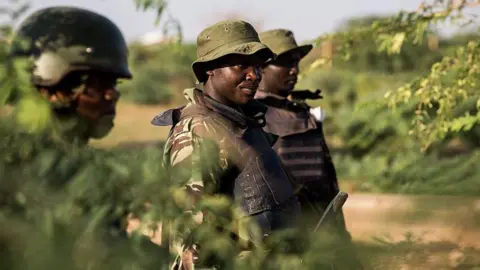
Challenges faced by the Nigerian military are compounded by pressures from militant jihadists in the northeast, as well as criminal and communal violence in the northwest and central regions. Analysts point out that these operational strains, alongside limited resources and heightened public scrutiny, spotlight issues of discipline within the armed forces.